
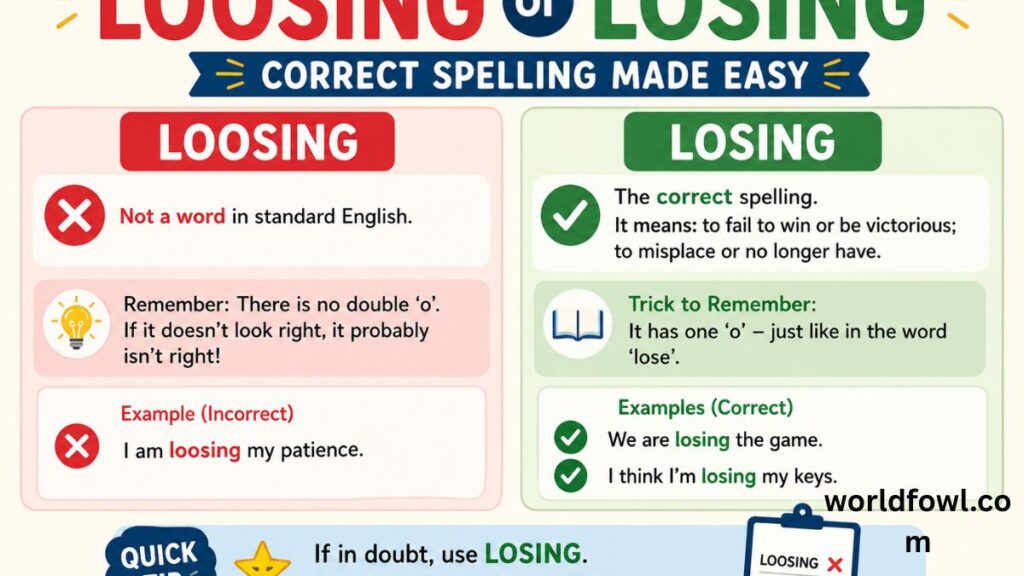
Spelling mistakes sneak into writing faster than a cat chasing a laser pointer. One tiny extra letter can change the entire meaning of a sentence. That’s exactly what happens with “loosing” or “losing.” People mix these words up every day in emails, blog posts, school assignments, and even business documents.
“Loosing” and “losing” look very similar, which is why many English learners and even native speakers confuse them. However, they have completely different meanings and uses. Understanding the difference helps you avoid common spelling mistakes and improves both your writing and speaking accuracy.
You’ve probably seen phrases like:
- “I’m loosing weight.”
- “We are loosing money.”
- “She’s loosing her mind.”
Here’s the catch. In almost every case above, the correct word is losing, not loosing.
This guide breaks everything down in plain English. You’ll learn the difference between lose and loose, understand the loosing meaning and losing meaning, and discover simple tricks that make the correct spelling stick forever.
By the end, you won’t second-guess yourself again.
Comparison Overview
Loosing and losing may look similar, but they have different meanings and come from different verbs.
- Losing comes from the verb lose and means failing to keep, win, or retain something.
- Loosing comes from the verb loose and means releasing, freeing, or letting something go.
Because these words differ by only one letter, they are often confused. However, choosing the wrong one can completely change the meaning of a sentence.
What Does “Loosing” Mean?
Loosing is the present participle of the verb loose.
It refers to the act of releasing, setting free, unfastening, or letting something move freely. This word is relatively uncommon in everyday conversation and is more often found in literary, historical, or technical contexts.
Examples:
- The archer was loosing arrows toward the target.
- The farmers were loosing the cattle into the pasture.
- She began loosing the ropes that secured the boat.
What Does “Losing” Mean?
Losing is the present participle of the verb lose.
It means no longer having something, failing to keep possession of it, or being defeated in a competition. This is the word most people intend to use in everyday writing and speech.
Examples:
- I keep losing my phone charger.
- Their team is losing the game by two points.
- He is losing confidence in the project.
Quick Tip
If you’re talking about misplacing something, being defeated, or no longer having something, use losing.
If you’re talking about releasing, freeing, or untying something, use loosing.
Quick Answer: Is It Losing or Loosing?
Here’s the short version.
| Word | Correct Meaning | Common Usage |
|---|---|---|
| Losing | Failing to keep, win, or maintain something | Very common |
| Loosing | Releasing or setting free | Rare |
So if you’re talking about:
- weight
- money
- focus
- patience
- games
- hope
…the correct spelling is almost always losing.
Examples
✅ “She is losing weight.”
❌ “She is loosing weight.”
“We are losing money.”
“We are loosing money.”
✅ “I’m losing my mind.”
❌ “I’m loosing my mind.”
The phrase “loosing arrows” is one of the few common situations where “loosing” works correctly because it means releasing arrows.
That distinction matters more than most people realize.
The Main Difference Between Losing and Loosing
The confusion usually starts with pronunciation. Both words sound similar. However, their meanings live in completely different neighborhoods.
Losing Meaning
The word losing comes from the verb “lose.” It describes:
- misplacing something
- failing to win
- experiencing defeat
- suffering financial loss
- declining emotionally
Examples
- Losing keys
- Losing confidence
- Losing focus
- Losing a game
- Losing sleep
In modern English, losing appears constantly in conversation and writing.
Loosing Meaning
The word loosing comes from “loose” or “loosen.” It means:
- releasing
- setting free
- untying
- letting something go
Examples
- Loosing arrows
- Loosing the ropes
- Loosing hunting dogs
You’ll mostly see this word in:
- historical English
- fantasy novels
- military writing
- archery discussions
That’s why many people ask, “Is loosing a real word?”
Yes, it is. It’s just uncommon.
Lose vs Loose: The Root of the Confusion
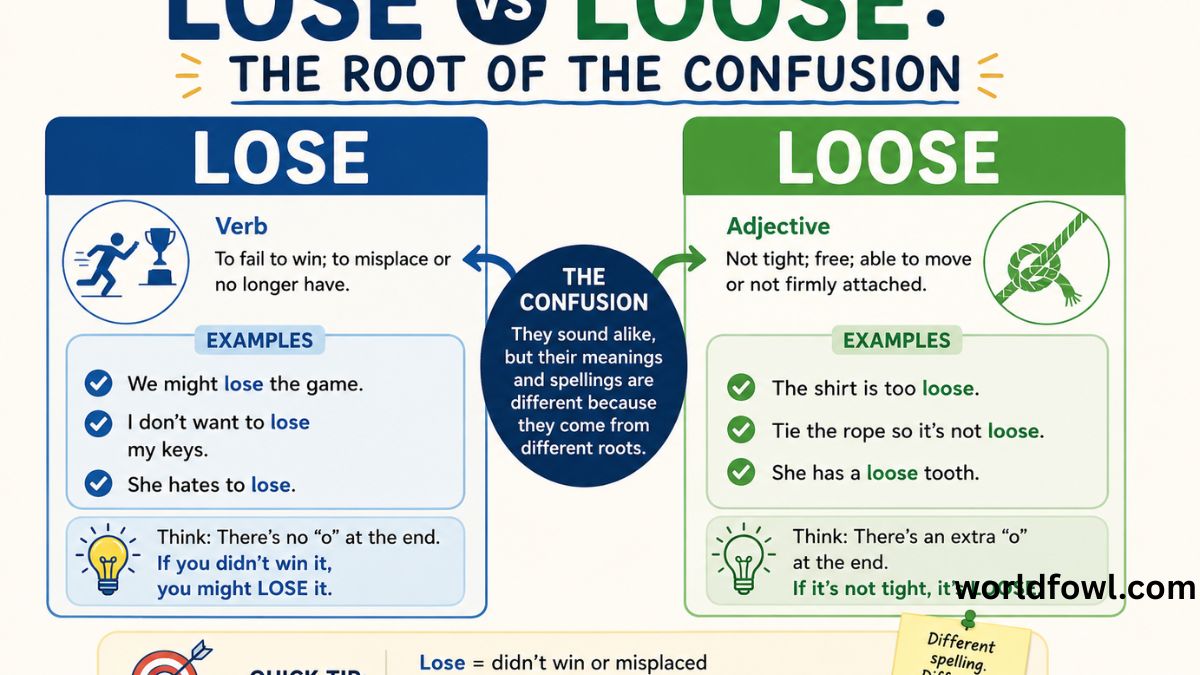
The biggest source of this spelling confusion comes from lose vs loose.
People accidentally carry the extra “o” from “loose” into “losing.”
Simple Breakdown
| Word | Type | Meaning |
|---|---|---|
| Lose | Verb | To fail to keep |
| Loose | Adjective | Not tight |
Lose Definition
The word “lose” means:
- to misplace
- to fail
- to no longer possess
Examples
- Don’t lose your wallet.
- They could lose the match.
- She didn’t want to lose hope.
Loose Definition
The word “loose” means:
- not tight
- free-moving
- not firmly attached
Examples
- The screw feels loose.
- He wore loose clothing.
- The dog got loose.
This tiny spelling difference causes thousands of common spelling mistakes every day.
Why People Confuse Lose and Loose
English spelling sometimes behaves like a prankster. Rules exist, yet exceptions jump out from dark corners.
Several reasons explain the confusion.
Pronunciation Tricks the Brain
“Lose” sounds like “looz.”
“Loose” sounds like “loos.”
That similarity makes writers assume “losing” should contain two O’s.
It doesn’t.
Autocorrect Creates Problems
Phones and spellcheck tools occasionally miss contextual errors.
For example:
“I’m loosing money.”
Technically, “loosing” is a real word. Because of that, spellcheck may not flag it.
Fast Typing Habits
Writers often type quickly during texting, casual writing, or social media posting. The fingers instinctively add another “o.”
That tiny typo changes the sentence meaning instantly.
Losing Meaning Explained With Real Examples
Understanding when to use losing becomes easier once you connect it with everyday situations.
Losing Something Physical
You can lose objects.
Examples
- Losing keys
- Losing a passport
- Losing your phone
- Losing documents
Example Sentence
“Jake kept losing his car keys every morning.”
Losing Emotionally
People also lose emotional stability, confidence, or motivation.
Examples
- Losing patience
- Losing hope
- Losing confidence
- Losing control
Example Sentence
“After weeks of stress, she started losing focus.”
Losing in Sports or Competition
The word appears constantly in sports.
Examples
- Losing a game
- Losing a tournament
- Losing a customer
- Losing an argument
Example Sentence
“The team hated losing close matches.”
Loosing Meaning Explained Clearly
Now let’s tackle the rarer word.
What Does Loosing Mean?
The word “loosing” means:
- releasing something
- untieing something
- setting something free
Think of a bowstring snapping forward.
That image helps many English learners remember the term.
Loosing Arrows Meaning
The phrase “loosing arrows meaning” often appears in historical fiction and fantasy books.
Example
“The archers began loosing arrows at dawn.”
In this sentence:
- arrows are being released
- the archers are firing them
That usage is grammatically correct.
Historical English Usage
Older English texts used “loosing” more frequently.
For example:
- loosing ships from docks
- loosing animals from cages
- loosing restraints
Modern English usually replaces it with simpler alternatives like:
- releasing
- untying
- freeing
Losing Weight or Loosing Weight?
This phrase causes massive confusion online.
Correct Phrase: Losing Weight
✅ “She is losing weight.”
❌ “She is loosing weight.”
Why?
Because weight is being reduced or lost. Nothing is being released physically like a rope or arrow.
Why the Mistake Happens
The phrase appears frequently in:
- fitness blogs
- gym posts
- social captions
- diet forums
Fast typing creates the typo repeatedly.
Search engines actually record thousands of searches for:
- is it losing weight or loosing weight
- correct phrase lose weight
That proves how widespread the confusion has become.
Losing Money or Loosing Money?
Another common typo appears in financial discussions.
Correct Usage
✅ “The company is losing money.”
❌ “The company is loosing money.”
The sentence refers to financial loss. Therefore, “losing” is correct.
Business Writing Tip
Using the wrong spelling in professional emails or reports can hurt credibility quickly.
Imagine this sentence in a client presentation:
“We are loosing revenue every quarter.”
That typo instantly distracts readers.
Strong business writing depends on accuracy.
Losing My Mind or Loosing My Mind?
This phrase appears everywhere online.
Correct Spelling
✅ “I’m losing my mind.”
❌ “I’m loosing my mind.”
The expression means:
- feeling overwhelmed
- mentally exhausted
- frustrated
It does not mean releasing your mind into the wild like a flock of pigeons.
Losing Hope Meaning
The phrase losing hope meaning refers to declining optimism or emotional strength.
Example
“After months without progress, he was losing hope.”
This phrase often appears in:
- emotional conversations
- literature
- motivational writing
- psychology discussions
Again, “loosing hope” would be incorrect.
Losing Track Meaning
The phrase losing track meaning refers to becoming unaware or forgetting details.
Examples
- Losing track of time
- Losing track of expenses
- Losing track of priorities
Example Sentence
“She kept losing track of deadlines.”
This expression appears constantly in modern English.
Losing vs Loss
Another grammar area creates confusion: losing vs loss.
Key Difference
| Word | Grammar Type | Meaning |
|---|---|---|
| Losing | Verb | Action happening now |
| Loss | Noun | Result of losing |
Examples
Losing
“They are losing customers.”
Loss
“The business suffered a major loss.”
One describes an action. The other names a condition or outcome.
Lose, Losing, and Lost Explained
The English verb family matters here.
Lose
Base form verb.
Examples
- Don’t lose your ticket.
- I could lose my temper.
Losing
Present participle.
Examples
- She is losing patience.
- We are losing time.
Lost
Past tense.
Examples
- He lost his wallet.
- They lost the game.
Quick Table
| Word | Verb Form |
|---|---|
| Lose | Present |
| Losing | Continuous |
| Lost | Past |
Understanding these verb forms improves writing clarity dramatically.
Loose, Loosen, and Loosening Explained
Now let’s examine the “loose” word family.
Loose
Adjective.
Example
“The jacket feels loose.”
Loosen
Verb.
Example
“Please loosen the knot.”
Loosening
Ongoing action.
Example
“He was loosening the ropes.”
These words relate to relaxing tightness or releasing something.
That’s why “loosing” connects more naturally with freeing objects.
Common Mistakes With Losing and Loosing
People repeat certain errors constantly.
Social Media Mistakes
Examples include:
- “I’m loosing followers.”
- “We’re loosing subscribers.”
- “Stop loosing focus.”
These appear everywhere online.
Academic Writing Errors
Students often write:
❌ “The company was loosing money.”
Teachers notice this instantly because it changes the intended meaning.
Resume Mistakes
Grammar mistakes damage credibility fast.
Employers may overlook candidates who submit sloppy writing.
That’s why proofreading matters.
Easy Trick to Remember Lose vs Loose
Memory tricks help tremendously.
The Extra “O” Rule
The word loose has an extra “o” because loose things have extra room.
That tiny association sticks surprisingly well.
Another Helpful Trick
Think about this:
- Lose → Lost
- Losing → Lost something
The spelling pattern stays consistent.
Quick Visual Diagram
LOSE → LOSING → LOST

LOOSE → LOOSEN → LOOSING
Simple. Clean. Easy to remember
Grammar Guide for Lose and Loose
English learners often struggle with this topic because the words look nearly identical.
Here’s a fast grammar reference.
| Word | Part of Speech | Meaning |
|---|---|---|
| Lose | Verb | Fail to keep |
| Losing | Verb form | Currently failing to keep |
| Lost | Past tense verb | Already failed to keep |
| Loose | Adjective | Not tight |
| Loosen | Verb | Make less tight |
| Loosing | Verb form | Releasing |
This table alone solves most grammar mistakes lose loose learners encounter.
Proper Use of Losing in Sentences
Learning through examples works better than memorizing definitions alone.
Correct Sentences
- She is losing confidence.
- We are losing customers.
- He keeps losing sleep.
- They’re losing the match.
- I’m losing patience.
These examples show proper use of losing in sentences naturally.
Proper Use of Loosing in Sentences
Although rare, “loosing” still belongs in English vocabulary.
Correct Sentences
- The soldiers were loosing arrows.
- He was loosing the horses from the stable.
- Sailors began loosing the ropes.
These examples focus on releasing or setting free.
Examples of Losing and Loosing Side by Side
Comparisons sharpen understanding quickly.
| Incorrect | Correct |
|---|---|
| Loosing weight | Losing weight |
| Loosing money | Losing money |
| Loosing my mind | Losing my mind |
| Loosing focus | Losing focus |
| Loosing arrows | ✅ Correct usage |
This side-by-side structure helps with spelling correction guide learning.
Why Correct Spelling Matters
Some people shrug off spelling mistakes. However, language shapes perception.
In Academic Writing
Teachers often associate spelling accuracy with:
- attention to detail
- communication skills
- writing competence
In Business Writing
Professional communication depends heavily on precision.
Typos can:
- confuse clients
- weaken trust
- distract readers
In SEO and Blogging
Search engines evaluate content quality constantly.
Clean writing improves:
- readability
- engagement
- trustworthiness
That’s why mastering correct English usage matters
English Grammar Tips for Avoiding Spelling Mistakes
Strong proofreading habits reduce errors dramatically.
Read Slowly
Most mistakes hide in rushed reading.
Read line by line instead.
Use Spellcheck Carefully
Spellcheck helps. However, it doesn’t catch contextual problems perfectly.
Remember:
- “Loosing” is technically valid.
- Your software may ignore the mistake.
Read Aloud
Hearing the sentence often reveals awkward wording immediately.
Focus on Context
Ask yourself:
“Am I talking about losing something or releasing something?”
That single question usually solves the problem.
Case Study: How One Letter Changes Meaning
Consider these two sentences.
Sentence One
“The army was losing arrows.”
Meaning:
- arrows disappeared somehow
Sentence Two
“The army was loosing arrows.”
Meaning:
- arrows were being fired
One extra “o” changes everything.
That’s the power of proper word usage.
Common English Errors Related to Lose and Loose
This isn’t the only confusing pair in English.
Many writers also struggle with:
| Incorrect Pair | Correct Difference |
|---|---|
| Your vs You’re | Possession vs contraction |
| Than vs Then | Comparison vs time |
| Affect vs Effect | Verb vs noun |
| Its vs It’s | Possession vs contraction |
English contains many tiny traps.
Still, awareness improves accuracy quickly.
How English Learners Can Master Lose vs Loose
Language learning takes repetition.
Best Practice Methods
Write Example Sentences
Create your own examples daily.
Use Flashcards
Pair:
- lose → fail to keep
- loose → not tight
Practice Context Recognition
Train your brain to identify whether the sentence involves:
- defeat
- misplacing
- releasing
- looseness
That distinction matters more than memorization alone.
Frequently Asked Questions
Is It Losing or Loosing?
In most situations, the correct spelling is losing.
Is Loosing a Real Word?
Yes. “Loosing” is a legitimate English word meaning releasing or setting free.
How Do You Spell Losing?
The correct spelling is:
L-O-S-I-N-G
Only one “o.”
What Does Loosing Mean?
It means:
- releasing
- untying
- setting free
Is It Lose Weight or Loose Weight?
The correct phrase is:
✅ Lose weight
❌ Loose weight
Why Is Lose Spelled With One O?
English spelling evolved over centuries through Germanic and French language influences. Pronunciation patterns changed over time while spellings remained relatively fixed.
That’s why English occasionally feels unpredictable.
Is Losing My Mind Correct?
Yes.
✅ “I’m losing my mind.”
That phrase means feeling mentally overwhelmed.
Is Losing Money Grammatically Correct?
Absolutely.
“Losing money” correctly refers to financial decline or loss.
What Are Common Lose vs Loose Mistakes?
Common examples include:
- loose weight
- loosing money
- loosing focus
- loose a game
These mistakes happen constantly online.
How Do You Use Loosing in a Sentence?
Example:
“The hunters were loosing arrows into the forest.”
Final Verdict: Losing Is Usually Correct
The debate around “loosing or losing” becomes simple once you understand the meanings.
Use losing when discussing:
- defeat
- misplacing something
- emotional decline
- financial loss
- reduced control
Use loosing only when describing:
- releasing
- untying
- setting free
Most modern writing requires “losing.”
That tiny spelling detail improves:
- writing clarity
- grammar accuracy
- professional communication
- SEO quality
- reader trust
And here’s the easiest memory trick of all:
If you mean “not winning” or “misplacing,” use losing.
If you mean “releasing,” use loosing.
Simple. Clean. Problem solved.
Related Grammar Guides
- Messege or Message?
- Piece Or Peice
- Than vs Then
- The 12 Essential Rules of English Grammar
- Piece Or Peice
- Messege or Message?

Worldfowl contributor Henry Collins is passionate about birds, wildlife, and the fascinating stories found in nature. With a deep interest in avian behavior, bird care, and global bird species, he creates engaging and informative content that helps readers better understand the world of fowl. His writing combines research, practical insights, and a love for nature to make bird-related topics simple, enjoyable, and educational for every reader.