

If you’ve ever taken a standardized test, filled out a survey, or sat through a classroom quiz, you’ve seen this phrase dozens of times. “Which of the following” appears everywhere — from the SAT to corporate compliance forms to IELTS practice sheets. Yet despite how common it is, plenty of people still get the grammar wrong. They write “followings.” They use “are” when they should use “is.” They drop the phrase into casual conversation where it sounds stiff and robotic.
This guide fixes all of that. You’ll walk away knowing exactly what which of the following meaning is, when to use it, how to avoid the most embarrassing grammar mistakes, and what to say instead when the phrase doesn’t fit.
Quick Answer
“Which of the following” is a formal English phrase used to introduce a selection question — asking someone to pick one or more answers from a predefined list. It’s a staple of multiple choice questions, research surveys, standardized tests, and academic writing. The word “following” is always singular and never takes an “s.” The verb that comes after (is or are) depends on whether you expect one answer or several. It’s a high-formality phrase — perfectly at home on an exam paper, but awkward in a text message.
What Does “Which of the Following” Mean?
Let’s pull the phrase apart, word by word.
- Which — a question determiner asking for identification from a group
- Of — a preposition linking “which” to the list it refers to
- The — the definite article, indicating a specific, known list
- Following — a collective noun meaning “the items listed below”
Put it all together, and the phrase essentially means: “From the options I’m about to show you, identify the correct one(s).”
Think of it like a verbal arrow. The phrase points forward — at a list that comes right after it. That’s why it only works when a defined set of choices follows. Without the list, the phrase collapses. It’s not a standalone question; it’s a setup.
“Which of the following is a type of renewable energy?
The phrase sets the stage. The answer options — solar, coal, natural gas, wind — complete it. Remove the options, and you’ve got half a sentence.
Grammatically, “which of the following” functions as a determiner phrase within a larger interrogative sentence. “Following” here acts as a collective noun — it refers to the entire list as a single unit. That’s why it never gets an “s.” You’re not counting individual followings; you’re pointing to one collective set.
The Grammar Behind the Phrase (Most Explanations Skip This)
Here’s where things get genuinely interesting — and where most English grammar guides gloss over the details.
The phrase “which of the following” doesn’t control the verb. The expected answer does.
This trips up even confident English speakers. They see “following” and think: plural noun → plural verb → “are.” But that logic is wrong. The verb must agree with the implied answer — the thing being identified, not the list itself.
Sentence structure matters here. Consider this:
- “Which of the following is the correct definition?” → One definition expected → singular verb
- “Which of the following are examples of mammals?” → Multiple examples expected → plural verb
The noun “following” stays the same. What changes is the number of correct answers the question is designed to produce.
A useful mental shortcut: ask yourself, “How many answers am I looking for?” One? Use is. More than one? Use are. That’s subject-verb agreement in action.
“Which of the Following Is” or “Which of the Following Are”? The Real Rule
This is the most-searched grammar question connected to this phrase — and for good reason. The “which of the following is or are” debate confuses ESL learners and native speakers alike.
Here’s the clean breakdown:
| Situation | Correct Verb | Example |
|---|---|---|
| One correct answer expected | Is | Which of the following is a synonym for “happy”? |
| Multiple correct answers expected | Are | Which of the following are prime numbers? |
| Uncountable noun as answer | Is | Which of the following is correct? |
| Collective noun as answer | Is | Which of the following is a group of animals called? |
The bottom line: the verb agrees with what you’re looking for, not with “following.”
A quick self-check before you write: imagine filling in the blank — “The answer _____.” If you’d say “The answer is…” use is. If you’d say “The answers are…” use are. Simple.
One more thing — “which of the following is correct” is one of the most searched variations of this phrase on Google. It’s singular because only one option is expected to be correct in most standard quiz formats.
“Which of the Following” vs. “Which of the Followings” — Why One Is Always Wrong
Let’s be direct: “which of the followings” is never correct. Not in formal writing, not in casual writing, not anywhere in standard English.
Here’s why. In this phrase, “following” functions as a collective noun — it refers to an entire list as one unit. Collective nouns don’t take a plural “s” when used this way. You wouldn’t say “furnitures” or “informations” — same principle applies here.
The only situation where “followings” is valid in English is when referring to fan bases or groups of supporters:
- “The band has a large following.” ✓
- “Both artists have dedicated followings.” ✓
But the moment you’re pointing to a list of options in a question? It’s always “following.” No exceptions. No debate.
| Phrase | Correct? | Why |
|---|---|---|
| Which of the following | ✓ | “Following” = collective noun pointing to a list |
| Which of the followings | ✗ | Can’t pluralize a collective noun in this context |
| Which of these following | ✗ | Redundant — pick one |
| Which of the below | ✓ (informal) | Acceptable but less formal |
When and Where to Use “Which of the Following” Correctly
The phrase isn’t just for tests. It shows up in several professional and academic contexts — each with slightly different expectations.
In Academic and Standardized Tests
Standardized tests like the SAT, GRE, IELTS, TOEFL, and USMLE have been using this phrase for decades. Why? Because it’s precise. It signals a closed-set question — the answer exists within the options provided. Test-takers don’t need to generate a response from scratch; they select from what’s given.
This matters for reading comprehension and instructional grammar sections especially. The phrase removes ambiguity about what kind of response is required. That’s not an accident — it’s deliberate educational question design.
Example:
Which of the following best describes the author’s tone in paragraph three? A) Sarcastic B) Optimistic C) Neutral D) Hostile
In Formal Surveys and Research
Research surveys use this phrase constantly. It standardizes responses, making data easier to analyze. Whether you’re designing a survey question format for a medical study or a customer feedback form, “which of the following” tells respondents exactly what to do: choose from this list.
Example from a healthcare survey:
Which of the following symptoms have you experienced in the past 30 days? ☐ Fatigue ☐ Shortness of breath ☐ Joint pain ☐ None of the above
In Professional and Business Communication
Professional communication skills sometimes call for this phrase in RFPs (Request for Proposals), compliance checklists, and HR assessments. It keeps questions objective and eliminates vague, open-ended responses.
However — and this is worth flagging — if you’re writing an internal email or a Slack message, this phrase will feel stiff. It doesn’t belong in conversational professional writing style. Save it for documents, forms, and formal assessments.
In Academic Writing and Research Papers
Academic writing occasionally uses “which of the following” when presenting criteria, research categories, or methodological options. It often introduces a formatted list, followed by a colon:
The study examined which of the following variables predicted student performance: study hours, sleep quality, classroom engagement, and parental involvement.
Note the colon placement — it comes after the phrase when a list immediately follows.
Real-World Sentence Examples (With Analysis
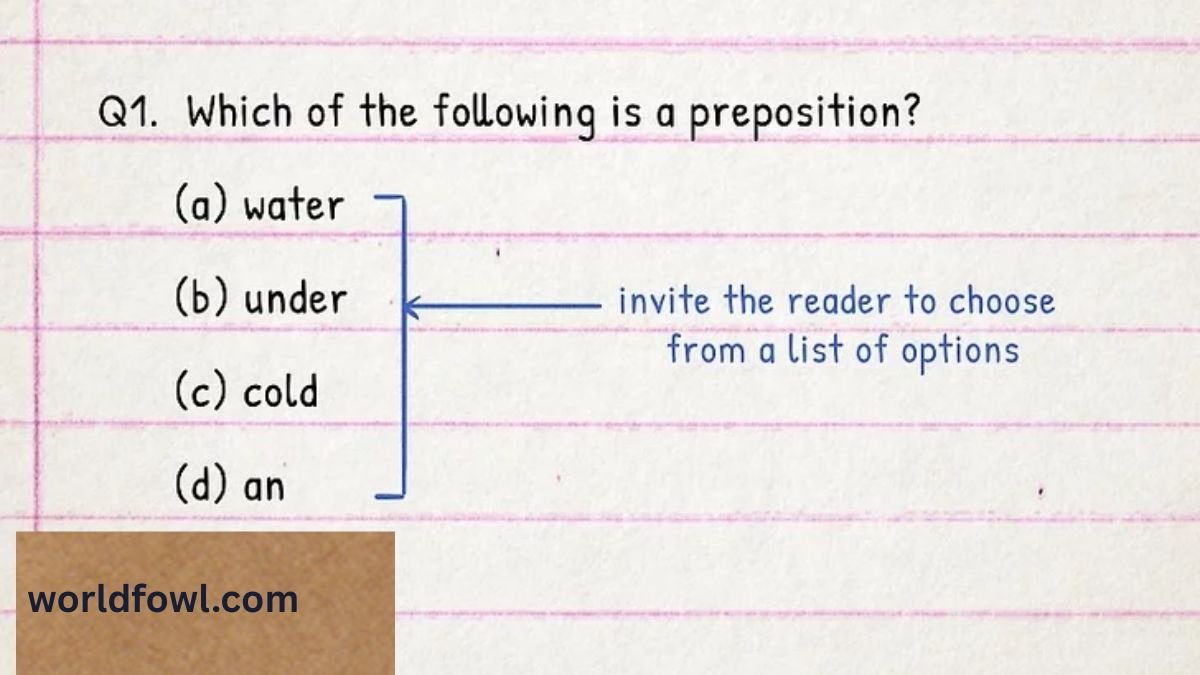
Good examples beat abstract rules every time. Here are five real-world uses of this phrase, with a breakdown of why each one works.
Grammar Context Example
“Which of the following sentences is grammatically correct?”
Why it works: One sentence can be correct — singular verb. This is a classic instructional grammar format used in grammar learning for beginners and ESL classrooms alike.
Science Test Example
“Which of the following are characteristics of viruses?”
Why it works: Multiple characteristics expected — plural verb. This is standard multiple choice question format in biology and standardized testing language.
Workplace HR Survey Example
“Which of the following best describes your role in the organization?”
Why it works: Formal, neutral, and clear. Perfect survey question format for HR use. One role expected — “is” would also work here, but omitting it keeps it concise.
Legal and Compliance Example
“Which of the following disclosures is required under Section 5 of the Data Protection Act?”
Why it works: High-stakes, formal context. Singular verb because one specific disclosure is the correct answer. This kind of formal question phrasing is standard in compliance training modules.
Everyday Conversation Attempt (And Why It Falls Flat)
“Hey, which of the following do you want for lunch — pizza or tacos?”
Why it sounds odd: Native speakers don’t talk like this. You’d say “Do you want pizza or tacos?” The phrase carries too much formality for everyday speech. Grammar for ESL learners often highlights this register mismatch as a key distinction to master.
“Which of the Following” vs. Similar Phrases — What’s the Difference?
Not every question needs this phrase. Here’s how it stacks up against common alternatives:
| Phrase | Formality Level | Best Context | Key Distinction |
|---|---|---|---|
| Which of the following | High | Exams, forms, academic papers | List comes after the phrase |
| Which of these | Medium | Conversations, casual writing | Items already visible or mentioned |
| Choose the correct answer | Medium | Test instructions | A command, not a question |
| Select one | Low–Medium | Digital forms, UI/UX | Simple, interface-friendly |
| What is the correct… | Medium | General Q&A | Can be open-ended or listed |
| Pick the best option | Low | Informal quizzes, icebreakers | Casual register |
The sharpest distinction is between “which of the following” and “which of these.”
- “Which of the following” → the list comes after the phrase; you’re pointing forward
- “Which of these” → the items are already visible or have been mentioned; you’re pointing back
“Which of these cities have you visited?” (They’ve been listed or shown already.) “Which of the following cities are in South America?” (The list comes next.)
Small difference, but it changes the sentence structure entirely.
Common Grammar Mistakes — And Exactly How to Fix Them
Common English mistakes with this phrase fall into five predictable categories. Knowing them means you won’t make them.
Mistake 1 — Writing “Followings”
❌ Which of the followings is correct? ✅ Which of the following is correct?
Fix: Delete the “s.” Always. No exceptions.
Mistake 2 — Wrong Verb Agreement
❌ Which of the following are the capital of Japan? ✅ Which of the following is the capital of Japan?
Fix: There’s only one capital. One expected answer = singular verb.
Mistake 3 — Leaving the List Out
❌ Please indicate which of the following. ✅ Please indicate which of the following applies to your situation: Option A, Option B, or Option C.
Fix: The phrase needs a list. Without one, the sentence is incomplete.
Mistake 4 — Using It in Casual Speech
❌ Hey, which of the following snacks would you like? ✅ Hey, which snack do you want?
Fix: Drop the formality in conversation. “Which of the following” belongs in documents and assessments, not small talk.
Mistake 5 — Punctuation Errors
❌ Which of the following, is the correct answer? ✅ Which of the following is the correct answer?
Fix: No comma between “following” and the verb. The phrase flows directly into the rest of the sentence.
Why Multiple-Choice Questions Rely on This Phrase
There’s a real reason quizzes and exams lean on this phrase so heavily — and it’s not just tradition.
Cognitive clarity: The phrase signals instantly that this is a selection task. Test-takers don’t wonder whether they should write an explanation, draw a diagram, or give a one-word answer. The format is clear before they even read the options.
Neutrality and objectivity: The phrase doesn’t hint at the answer. Compare it to a leading question like “Don’t you agree that photosynthesis requires sunlight?” — that nudges the respondent. “Which of the following” stays neutral.
Scoring consistency: Because responses are constrained to a defined list, answers are easier to score objectively. This is why educational assessments, state licensing exams, and professional assessments all favor it.
Historical adoption: The phrase became standardized in American standardized tests during the mid-20th century, when large-scale educational testing expanded. Once the College Board and other testing bodies baked it into their formats, it spread across classroom exercises, online assessments, and educational content worldwide.
Does Formality Matter? Using “Which of the Following” in the Right Register
Formal English operates on a spectrum. “Which of the following” sits near the top — alongside phrases like “pursuant to” or “with respect to.” That’s appropriate in some contexts and jarring in others.
Here’s a practical guide:
| Context | Use “Which of the Following”? | Better Alternative |
|---|---|---|
| Academic paper or thesis | ✓ Yes | — |
| Standardized test question | ✓ Yes | — |
| HR or compliance form | ✓ Yes | — |
| Corporate email | ⚠ Use sparingly | “Which option works best for you?” |
| Slack or team chat | ✗ No | “Which one do you prefer?” |
| Text message | ✗ No | “Pizza or tacos?” |
| Classroom discussion | ⚠ Situational | “Which of these makes more sense?” |
The rule of thumb: if you’d feel comfortable saying it at a podium during a formal presentation, it fits. If it would sound weird said out loud to a friend, rephrase it.
How Search Engines and AI Tools Interpret This Phrase
From an SEO and technology perspective, “which of the following” is what Google calls a question-based search intent query. When someone types it into a search bar, they’re usually:
- Looking for a grammar explanation
- Searching for help with a test or quiz question
- Trying to understand proper English grammar usage
Google’s featured snippet algorithm loves this phrase because it’s answerable — the content is specific, the answer is definable, and the format is clean. Pages that directly answer “which of the following is correct” with a clear rule and examples consistently appear in Position 0.
AI-powered quiz generators and online quiz creation tools treat “which of the following” as a standard stem structure — the opening of a multiple-choice question. Tools like Google Forms, Quizizz, and Kahoot are all built around this format because it’s universally understood across English language learning contexts globally.
For educational content creators: structuring your quiz questions around this phrase improves accessibility for grammar for ESL learners and international students who’ve been trained on standardized formats.
How to Write Better Multiple-Choice Questions Using This Phrase
If you’re creating classroom learning materials, online assessments, or exam preparation grammar content, here’s how to get the most out of this phrase.
Keep options grammatically parallel. If one option starts with a verb, they all should. Inconsistency is a readability problem and often gives away the answer.
❌
Which of the following best describes photosynthesis? A) Converts sunlight to energy B) A process used by plants C) Oxygen production D) Happens in chloroplasts
✅
A) Converts sunlight into chemical energy B) Produces oxygen as a byproduct C) Occurs in the chloroplasts of plant cells D) Requires carbon dioxide and water
Match the verb to the expected answer count. One correct answer? Use “is.” Multiple correct answers? Use “are” — and tell respondents to “select all that apply.”
Avoid grammatical clues. If the stem ends with “an ____” and only one option starts with a vowel, you’ve accidentally hinted at the answer. Rewrite the stem to end at “which of the following.”
Use simple language. The phrase itself is formal enough — the rest of the question should be clear and direct. Writing clear questions means avoiding jargon unless the subject demands it.
Quick checklist before publishing any question:
- [ ] Is it “following” (not “followings”)?
- [ ] Does the verb match the expected number of correct answers?
- [ ] Are all answer options grammatically consistent?
- [ ] Is the question clear even without the answer choices?
- [ ] Does the phrasing accidentally hint at the answer?
FAQs — “Which of the Following” Grammar Questions Answered
What does “which of the following” mean in plain English?
It means: “From the list I’m about to show you, pick the correct answer(s).” It’s a formal phrase used to introduce choice-based questions in tests, surveys, and academic documents. The “following” refers to the list that comes right after the phrase.
Is “which of the following” singular or plural?
The phrase itself is neither — it’s a determiner phrase. The verb that follows (is or are) depends on how many correct answers the question expects. One correct answer → is. Multiple correct answers → are. This is a core verb agreement rule in English.
Can you ever say “which of the followings”?
No. In this context, “followings” is always incorrect. “Following” functions as a collective noun pointing to a defined list — and collective nouns in this use don’t take a plural “s.” The only valid use of “followings” in English refers to fan bases or groups of supporters, which is a completely different meaning.
Is “which of the following” only for tests and exams?
Not at all. It’s common in research surveys, legal compliance documents, HR assessments, academic papers, and any formal writing usage where someone must choose from a defined set of options. That said, it’s out of place in casual emails or everyday conversation.
How formal is “which of the following”?
Very formal. It’s high-register formal English — appropriate for academic papers, standardized tests, professional assessments, and official forms. In informal settings, simpler alternatives like “which one” or “which of these” fit better.
What’s the difference between “which of the following” and “which of these”?
“Which of the following” points forward — the list comes after the phrase. “Which of these” points backward or sideways — the items have already been mentioned or are visible. It’s a subtle but important structural difference in sentence formation rules.
Conclusion — Three Rules That Cover Everything
“Which of the following” is a precise, formal phrase with a clear job: it introduces selection questions where the options come right after it. Get it right, and your writing sounds authoritative and professional. Get it wrong, and even a small error like “followings” can undermine your credibility.
Here are the three rules that cover 95% of situations:
- Always write “following” — never “followings.” It’s a collective noun. The “s” doesn’t belong.
- Match the verb to the expected answer. One answer → “is.” Multiple answers → “are.”
- Keep it formal. Use this phrase in tests, surveys, and academic documents. In everyday conversation, reach for something simpler.
Master those three, and you’ve cracked the grammar of this phrase completely. Apply them every time you write a quiz question, design a survey, or proofread an academic document — and you’ll always get it right.

Worldfowl contributor Henry Collins is passionate about birds, wildlife, and the fascinating stories found in nature. With a deep interest in avian behavior, bird care, and global bird species, he creates engaging and informative content that helps readers better understand the world of fowl. His writing combines research, practical insights, and a love for nature to make bird-related topics simple, enjoyable, and educational for every reader.