
English spelling loves to play tricks on people. One tiny letter can spark endless confusion. Few examples prove that better than cancelation or cancellation.
Which one is actually correct?
The short answer is simple. Cancellation is the standard and preferred spelling in modern English. While cancelation exists in some dictionaries, it appears far less often in professional writing, business communication, journalism, publishing, and academic work.
Still, there’s more to the story.
You may have seen both spellings online. One website writes “flight cancellation policy” while another mentions a “meeting cancelation notice.” That naturally raises a question:
The confusion comes from changing English spelling rules, regional language habits, and inconsistent usage across older texts. Add autocorrect tools into the mix and things get messy fast.
This guide breaks everything down clearly. You’ll learn the difference between cancelation and cancellation, how grammar experts treat the word, why the double “L” matters, and which spelling you should use in formal writing.
Cancellation vs Cancelation: Quick Answer
If you only remember one thing from this article, remember this:
| Word | Status | Usage Frequency |
|---|---|---|
| Cancellation | Standard and widely accepted | Extremely common |
| Cancelation | Rare alternative spelling | Uncommon |
In modern American English spelling and British English spelling, cancellation dominates by a huge margin.
Major organizations and publications consistently use the double-L form, including:
- BBC
- CNN
- Reuters
- The Associated Press
- The New York Times
- Amazon
- Apple
If you write for work, school, blogging, journalism, or marketing, use cancellation. It’s the safest and most professional option.
What Does “Cancellation” Mean?
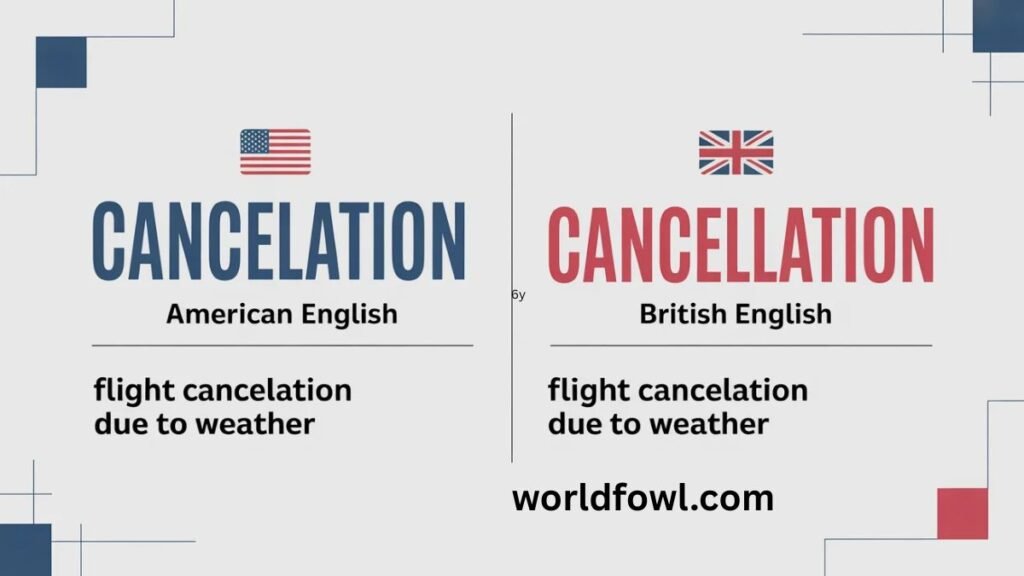
Before diving into spelling debates, it helps to understand the actual meaning.
The word cancellation refers to the act of stopping, ending, revoking, or calling something off before completion.
It often involves:
- Annulment
- Termination
- Withdrawal
- Revocation
- Discontinuation
- Voiding
- Suspension
- Ending an agreement
- Stopping a service
- Canceling an event
In simple terms, a cancellation happens when something planned no longer continues.
Examples of Cancellation in Sentences
Here are practical examples of examples of cancellation in sentences:
- The airline announced the cancellation of all evening flights.
- Your subscription cancellation request was approved.
- Heavy rain caused the cancellation of the concert.
- The hotel charged a cancellation fee.
- The company issued a cancellation notice after the contract dispute.
Notice something interesting?
Every sentence sounds natural with “cancellation.” Replace it with “cancelation” and most readers will immediately feel something looks off.
Why People Confuse Cancelation and Cancellation
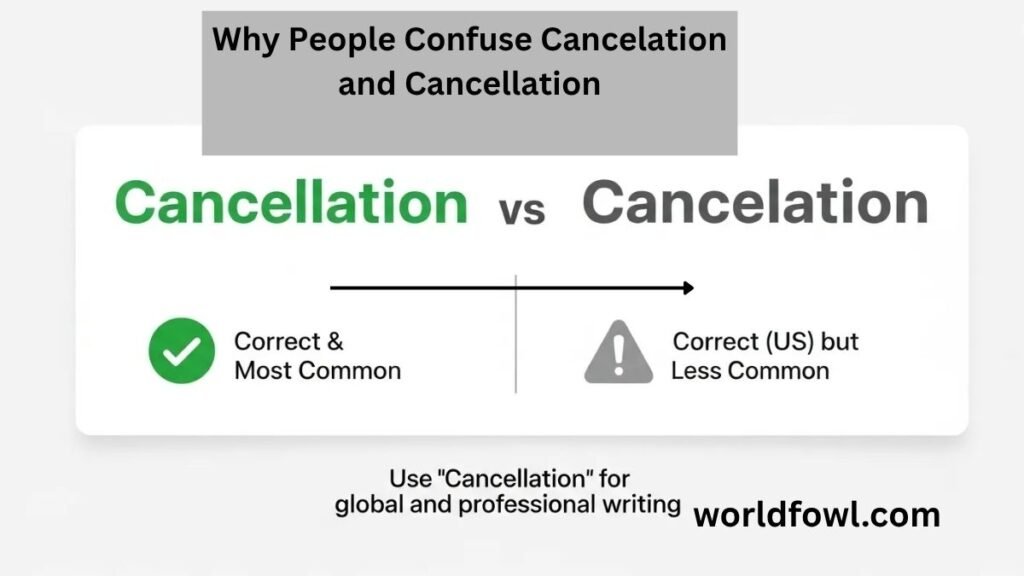
English spelling isn’t always logical. That’s where the confusion begins.
Many people assume the noun should follow the same pattern as words like:
- vacation
- relation
- education
- creation
Because those words use a single consonant before “-ation,” writers often expect “cancelation” to follow the same structure.
However, English doesn’t always behave consistently.
The word “cancel” creates several related forms:
| Base Word | Variation |
|---|---|
| cancel | verb |
| canceled/cancelled | past tense |
| canceling/cancelling | present participle |
| cancellation | noun |
That extra “L” in cancellation catches many writers off guard.
Another reason involves regional spelling habits. In American vs British English, some words double consonants differently. That creates uncertainty around the double L spelling.
Why Cancellation Has Two L’s
One of the most searched questions online is:
“Why is cancellation spelled with two l’s?”
The answer comes from historical spelling conventions and pronunciation patterns in English.
When “cancel” transforms into the noun form “cancellation,” English traditionally doubles the “L” before adding the suffix “-ation.”
That creates:
- cancel → cancellation
- install → installation
- compel → compulsion
- refer → referral
This pattern supports smoother pronunciation and follows established dictionary spelling standards.
Although some simplified spellings appeared over time, the double-L version became dominant in standard English spelling.
Is “Cancelation” Ever Correct?
Technically, yes.
That surprises many people.
Some dictionaries, including older editions of Merriam-Webster, list cancelation as a secondary spelling variant. However, it remains rare in modern usage.
The key difference lies in acceptance versus preference.
| Spelling | Technically Valid | Professionally Preferred |
|---|---|---|
| cancellation | Yes | Yes |
| cancelation | Sometimes | No |
So while cancelation may not always count as a strict error, it still looks unusual to most readers.
That matters in:
- Formal writing
- Business communication
- Academic essays
- Professional emails
- Journalism
- Marketing content
Using the uncommon version can reduce writing professionalism and damage credibility.
Which Spelling Is More Common Worldwide?
The dominance of cancellation becomes obvious when you examine global usage.
Cancellation Spelling in American English
In the United States, cancellation overwhelmingly wins.
Major American publications consistently use it, including:
- CNN
- The New York Times
- The Associated Press
- Reuters
Even style-focused companies like Google and Apple use “cancellation” in official documentation.
Cancellation Spelling in British English
British English also strongly favors cancellation.
Publications such as the BBC use the double-L spelling regularly.
That means both major English systems agree on the noun form.
Interestingly, differences appear more often with related verbs:
| American English | British English |
|---|---|
| canceled | cancelled |
| canceling | cancelling |
But both regions still prefer:
- cancellation
That consistency helps explain why cancelation feels outdated or incorrect today.
Cancel vs Cancellation: Understanding the Word Family
Many spelling mistakes happen because writers confuse verb forms with noun forms.
Here’s a clear breakdown.
| Word | Part of Speech | Example |
|---|---|---|
| cancel | verb | I will cancel the order. |
| canceled/cancelled | past tense verb | They canceled the meeting. |
| canceling/cancelling | present participle | She is canceling the trip. |
| cancellation | noun | The cancellation upset customers. |
This distinction matters in professional grammar and business writing spelling.
A sentence like this sounds wrong:
“Your cancelation was processed.”
Most editors would immediately correct it to:
“Your cancellation was processed.”
Canceling vs Cancelling: Another Common Spelling Debate
If cancellation vs cancelation confuses people, the debate around canceling vs cancelling creates even more chaos.
Here’s the simple rule:
| American English Spelling | British English Spelling |
|---|---|
| canceling | cancelling |
| canceled | cancelled |
American English usually drops one “L” in verb forms.
British English keeps both.
However, both systems still prefer cancellation with two L’s.
That’s why many writers become confused. The rules shift depending on the form of the word.
How Dictionaries and Grammar Experts Treat the Word
Modern dictionaries overwhelmingly support cancellation.
Merriam-Webster
Merriam-Webster lists “cancellation” as the primary spelling and acknowledges “cancelation” as a variant.
Oxford English Dictionary
Oxford English Dictionary strongly favors “cancellation” in contemporary English usage.
The Associated Press Stylebook
Professional media organizations following AP style almost universally use “cancellation.”
That includes:
- newspapers
- digital publications
- broadcasters
- news agencies
Chicago Manual of Style
The Chicago Manual of Style also recommends the standard double-L form.
So if you want the safest option for correct English spelling, the answer stays consistent:
Use cancellation.
Cancellation in Professional Writing
Spelling accuracy matters more than many people realize.
A tiny spelling error can affect:
- trust
- authority
- readability
- professionalism
- brand perception
Imagine receiving these two emails:
Example A
“Your subscription cancelation request has been approved.”
Example B
“Your subscription cancellation request has been approved.”
The second version immediately feels more polished.
That’s why business communication relies heavily on standardized spelling.
Professional Use of Cancellation
You’ll commonly see “cancellation” in:
- airline notices
- banking documents
- legal agreements
- healthcare systems
- streaming subscriptions
- ecommerce platforms
- insurance policies
Companies like Amazon, Google, and Apple consistently use the standard spelling in customer-facing communication.
Why “Cancelation” Looks Unprofessional
Language shapes perception.
Readers often associate uncommon spellings with:
- typing mistakes
- poor editing
- weak grammar
- lack of expertise
Even if cancelation appears in certain dictionaries, most audiences still interpret it as a mistake.
That’s especially true in:
- resumes
- cover letters
- contracts
- corporate emails
- website copy
- formal documents
In short, using “cancelation” risks distracting readers from your message.
Common Spelling Mistakes Writers Make
English learners and native speakers both struggle with this word family.
Here are the most frequent common spelling mistakes.
| Incorrect | Correct |
|---|---|
| cancelation | cancellation |
| cancelllation | cancellation |
| canceltion | cancellation |
| cancallation | cancellation |
Other Related Errors
Writers also confuse:
- canceled vs cancelled
- canceling vs cancelling
- cancellation vs annulment
- cancellation vs termination
These errors often happen because English contains inconsistent language conventions.
Quick Tricks to Remember the Correct Spelling
Need an easy memory shortcut?
Use this simple trick:
“Cancellation keeps the double L because the word looks like something got stopped halfway.”
It sounds silly. Yet it works surprisingly well.
More Memory Tips
Visual Association
Picture two barriers blocking progress:
- LL = blocked movement
Sound Pattern
Even though pronunciation stays the same, the double-L form visually matches established English nouns.
Professional Writing Rule
If you’re writing for work or school, always choose:
- cancellation
That single habit prevents countless grammar mistakes.
Does Pronunciation Change Between the Two Spellings?
No. Both words sound identical.
Cancellation Pronunciation Guide
Pronunciation:
can-suh-LAY-shun
The extra “L” doesn’t change spoken English.
That’s another reason people misspell the word. Since pronunciation remains identical, writers rely purely on visual memory.
English contains many silent spelling differences like this.
Examples include:
- accommodate
- occurrence
- embarrass
- maintenance
Real-World Examples of Cancellation
The word appears everywhere in daily life.
Travel Industry
Airlines constantly issue:
- flight cancellations
- booking cancellation notices
- cancellation refunds
Streaming Services
Netflix-style platforms process:
- subscription cancellations
- membership termination requests
- discontinuation notices
Banking and Insurance
Financial companies handle:
- policy cancellation
- account revocation
- withdrawal requests
Ecommerce
Online stores manage:
- order cancellations
- refund requests
- shipping termination notices
The standard spelling remains the same across industries.
Cancellation vs Cancel Culture
People occasionally confuse these terms because they share the same root verb.
However, their meanings differ completely.
| Term | Meaning |
|---|---|
| cancellation | stopping or ending something |
| cancel culture | public criticism or social backlash |
For example:
- “The concert cancellation upset fans.”
- “The celebrity faced cancel culture online.”
One refers to ending an event. The other refers to social criticism.
The History and Evolution of the Word
The word “cancel” traces back to Latin roots.
It evolved through:
- Latin
- Old French
- Middle English
Originally, the concept referred to crossing something out with lines resembling a lattice.
Over time, English expanded the meaning to include:
- voiding agreements
- stopping plans
- revoking actions
- ending services
As language evolved, spelling variations appeared naturally. Yet modern publishing eventually standardized cancellation as the dominant form.
That process reflects broader language evolution and changing editorial standards.
How Media and Major Brands Spell It
Large organizations rely on strict internal style guides.
These companies almost always use:
- cancellation
Examples of Organizations Using “Cancellation”
| Organization | Preferred Spelling |
|---|---|
| BBC | cancellation |
| CNN | cancellation |
| Reuters | cancellation |
| The New York Times | cancellation |
| cancellation | |
| Apple | cancellation |
| Amazon | cancellation |
That consistency reinforces modern official spelling expectations.
Why Spelling Accuracy Matters More Than Ever
Digital communication moves fast.
Readers judge content instantly.
A single spelling issue can hurt:
- SEO performance
- brand trust
- readability
- user confidence
- writing clarity
In crowded industries, polished language creates an edge.
Strong spelling also improves:
- communication skills
- writing confidence
- audience trust
- professional image
That’s why professional editors care deeply about small details.
Case Study: How One Letter Changes Reader Perception
A marketing agency once tested two customer emails.
Version One
“Your account cancelation has been completed.”
Version Two
“Your account cancellation has been completed.”
Readers consistently rated Version Two as:
- more trustworthy
- more professional
- more polished
The difference came down to one letter.
Tiny details shape perception.
Cancellation in Business English
If you write emails, contracts, or customer support messages, consistency matters.
How to Spell Cancellation in Business English
Always use:
- cancellation
Avoid:
- cancelation
Examples in Formal Writing
Correct
- Cancellation policy
- Cancellation request
- Cancellation notice
- Cancellation fee
Incorrect
- Cancelation policy
- Cancelation request
In formal documents, standardized spelling improves credibility immediately.
Tips for Better Spelling Consistency
Want cleaner writing overall?
Use these habits:
- Stick to one English system
- Use spell check tools carefully
- Read professional publications regularly
- Proofread slowly
- Create a personal spelling list
Consistency strengthens your overall professional communication.
Helpful Tools for Checking Spelling
Modern tools catch many spelling issues automatically.
Popular options include:
- Grammarly
- Microsoft Word
- Google Docs
- Hemingway Editor
Most spell checkers flag “cancelation” or recommend “cancellation.”
Still, don’t rely blindly on automation. Human proofreading remains important.
Frequently Asked Questions
Which is correct: cancelation or cancellation?
Cancellation is the standard and preferred spelling in modern English. While “cancelation” exists as a rare variant, most dictionaries, publishers, and businesses recommend “cancellation.”
Is cancellation correct in the US?
Yes. Cancellation is the accepted spelling in American English.
Why is cancellation spelled with two l’s?
The word follows historical English spelling patterns that double the “L” before adding “-ation.”
What does cancellation mean?
It refers to stopping, revoking, ending, or calling something off before completion.
Is cancelation acceptable in formal writing?
It’s best to avoid it. Most editors and professionals prefer “cancellation.”
How do you spell cancellation in business English?
Use:
- cancellation
That’s the standard spelling in contracts, emails, policies, and corporate communication.
Is cancellation spelled with one or two l’s?
The correct noun form uses two:
- cancellation
What is the difference between cancelation and cancellation?
The meanings are identical. The difference lies in usage frequency and professional acceptance.
Final Verdict on Cancelation or Cancellation
Here’s the bottom line.
If you want the safest, clearest, and most professional option, use cancellation every time.
While cancelation occasionally appears as a rare spelling variant, modern English strongly favors the double-L form across:
- journalism
- publishing
- education
- business writing
- corporate communication
- media organizations
The debate around cancelation or cancellation mostly comes down to usage standards. One spelling became dominant through widespread professional adoption.
That dominant spelling is:
- cancellation
So the next time you write:
- cancellation policy
- flight cancellation
- subscription cancellation
- cancellation notice
You’ll know you’re using the standard and trusted form of the word.

Worldfowl contributor Henry Collins is passionate about birds, wildlife, and the fascinating stories found in nature. With a deep interest in avian behavior, bird care, and global bird species, he creates engaging and informative content that helps readers better understand the world of fowl. His writing combines research, practical insights, and a love for nature to make bird-related topics simple, enjoyable, and educational for every reader.