

A yoke in the Bible is a wooden bar placed across the necks of two animals, usually oxen, to keep them walking together while pulling a load. Scripture uses this familiar farming tool as a vivid symbol of work, submission, discipline, and the burdens people carry under various authorities. Because it was part of everyday life in ancient Israel, the yoke became a meaningful image to express both hardship and guidance.
Across the pages of the Bible, this simple tool takes on deep spiritual significance, drawing readers into powerful lessons about freedom, obedience, and partnership with God. Its imagery invites people to reflect on what shapes their direction, what weighs on their lives, and what empowers them to move forward. The contrast between heavy yokes and freeing ones captures attention and sparks curiosity.
By exploring how the Bible uses the yoke, readers discover layers of meaning that speak to faith, leadership, relationships, and spiritual transformation. The concept reveals how God breaks oppressive burdens, guides His people, and offers a life-giving path through Christ’s gentle and restful yoke.
The Literal Meaning of a Yoke
Picture two oxen working side by side in a field. What connects them? A wooden frame called a yoke.
This simple harness revolutionized ancient agriculture. Farmers would place this curved beam across the necks of two animals, binding them together for plowing fields or pulling heavy loads. The design distributed weight evenly between both creatures, making impossible tasks suddenly manageable.
Here’s what made yokes essential in biblical times:
- They doubled work capacity instantly
- They allowed older, experienced animals to train younger ones
- They required both animals to move in sync
- They prevented animals from wandering or working against each other
- They symbolized partnership and shared purpose
The craftsmanship mattered tremendously. A poorly fitted yoke would chafe, cause pain, and reduce productivity. Skilled woodworkers would custom-carve each yoke to fit specific animals perfectly. This attention to detail becomes crucial when we examine Jesus’ promise about His yoke later.
Ancient Israelites encountered yokes daily. Every farmer, merchant, and traveler understood this tool intimately. When biblical writers used “yoke” as a spiritual analogy, their audience immediately grasped the implications.
The physical reality created a perfect Old Testament symbolism for deeper truths. Just as animals bore physical burdens together, humans would bear spiritual ones—either under oppression or in godly partnership with their Creator.
The Symbolic Meaning of a Yoke in Scripture
Scripture transforms this agricultural tool into a multifaceted symbol. The Bible employs yoke imagery to illustrate spiritual burdens, relationships, and the nature of discipleship itself.
Three primary symbolic meanings emerge throughout biblical texts. Each reveals something critical about our spiritual condition and God’s plan for humanity.
A Yoke as Bondage or Oppression
The darkest biblical usage of yoke represents spiritual bondage and oppression. When God’s people fell into sin or foreign powers enslaved them, prophets described their suffering as bearing a yoke.
Leviticus 26:13 declares: “I am the Lord your God, who brought you out of the land of Egypt, that you should not be their slaves. And I have broken the bars of your yoke and made you walk erect.”
This passage connects Egypt’s physical slavery directly to the yoke metaphor. God didn’t just free Israel from brutal taskmasters—He shattered their yoke, restoring their dignity and upright posture.
The prophet Isaiah expands this imagery in Isaiah 58:6: “Is not this the fast that I choose: to loose the bonds of wickedness, to undo the straps of the yoke, to let the oppressed go free, and to break every yoke?”
Here, the yoke represents religious burdens, moral burden, and social injustice simultaneously. True worship involves breaking these oppressive yokes others bear.
Jeremiah 27:8 warns: “But if any nation or kingdom will not serve this Nebuchadnezzar king of Babylon, and put its neck under the yoke of the king of Babylon, I will punish that nation with the sword, with famine, and with pestilence, declares the Lord.”
Even conquest becomes a yoke—but notice that resisting God’s purposes through that conquest brings worse consequences. Sometimes God allows oppressive yokes to accomplish divine guidance and correction.
Lamentations 3:27 offers surprising counsel: “It is good for a man that he bear the yoke in his youth.”
This shifts our understanding. Not all yokes equal pure evil. Some discipline and form character. The timing matters too—bearing certain burdens while young builds strength for later challenges.
A Yoke as Bondage or Oppression
| Biblical Reference | Type of Yoke | Purpose/Meaning |
|---|---|---|
| Leviticus 26:13 | Egyptian slavery | God breaks oppressive yokes |
| Isaiah 58:6 | Wickedness and injustice | Believers should free the oppressed |
| Jeremiah 27:8 | Foreign conquest | Sometimes permitted for correction |
| Lamentations 3:27 | Youthful discipline | Character formation through hardship |
The yoke of sin appears throughout these passages. When humanity rebels against God, we don’t gain freedom—we exchange His gentle yoke for sin’s crushing weight. Romans 6:16 explains: “Do you not know that if you present yourselves to anyone as obedient slaves, you are slaves of the one whom you obey, either of sin, which leads to death, or of obedience, which leads to righteousness?”
Spiritual oppression manifests when we serve anything besides God. Money becomes a yoke. Addiction becomes a yoke. Pride, lust, and anger all fashion their own burden that we drag through life.
A Yoke as Submission to God
What Is a Yoke in the Bible? The flip side reveals a stunning paradox. Wearing God’s yoke represents submission, yes—but also divine calling, purpose, and godly obedience.
Ancient Israel understood covenant obedience as wearing God’s yoke. His laws, commandments, and expectations formed a framework that—when followed—produced righteous living and national flourishing.
This wasn’t legalism vs. grace in the negative sense. The covenant relationship between God and Israel functioned like that wooden yoke connecting two oxen. God provided direction and power. Israel provided willing cooperation.
When they walked in sync, everything worked. Harvests came. Enemies fell. Prosperity flowed. But when Israel bucked against God’s direction, chafing and pain resulted—not because God’s yoke was harsh, but because they fought against it.
Here’s what submission to God’s yoke provided:
- Clear moral alignment with divine standards
- Protection from self-destructive choices
- Community identity rooted in shared values
- Spiritual discipline that formed character
- Access to God’s divine guidance and wisdom
The yoke of religious responsibility carried weight, certainly. Sacrifices required time and resources. Sabbath observance meant lost productivity. Dietary laws complicated meals. Sexual ethics limited options.
Yet prophets consistently argued these “restrictions” actually liberated Israel from worse bondage. Galatians 5:1 captures this tension: “For freedom Christ has set us free; stand firm therefore, and do not submit again to a yoke of slavery.”
Paul warns against returning to legalism—treating God’s law as a means of earning salvation. That perverts the yoke from loving partnership into crushing oppression.
True spiritual submission resembles an apprentice learning from a master craftsman. The apprentice submits to instruction, correction, and guidance—not as a slave, but as someone being shaped into something greater.
Jesus’ Yoke: Rest for the Soul
Matthew 11:28-30 contains perhaps the most beloved passage about yokes in all Scripture:
“Come to me, all who labor and are heavy laden, and I will give you rest. Take my yoke upon you, and learn from me, for I am gentle and lowly in heart, and you will find rest for your souls. For my yoke is easy, and my burden is light.”
This New Testament teaching revolutionizes yoke symbolism. Jesus doesn’t promise to remove all yokes—He offers to exchange them.
Notice the progression. First, He invites the exhausted: “all who labor and are heavy laden.” These people already wear yokes—the yoke of sin, spiritual burdens from guilt and shame, religious burdens from Pharisaical legalism, or simple life exhaustion.
Second, He promises rest. Not vacation or escape, but deep spiritual rest that penetrates the soul even while working.
Third, He introduces His own yoke: “Take my yoke upon you.” This shocks the original audience. Rabbis typically offered “yokes” of theological interpretation and legal interpretation. But Jesus offers something radically different.
Jesus’ Yoke: Rest for the Soul
Fourth, He emphasizes learning: “learn from me.” The yoke becomes a discipleship tool. You’re paired with Jesus Himself, walking beside Him, matching His pace, learning His methods.
Fifth, He describes His character: “gentle and lowly in heart.” Unlike harsh taskmasters, Jesus leads with kindness. Unlike proud rulers, He serves humbly.
Sixth, He repeats the promise: “you will find rest for your souls.” This spiritual rest transcends physical circumstances. Persecuted Christians, impoverished believers, and martyrs all accessed this rest while bearing external hardships.
Finally, He clarifies: “my yoke is easy, and my burden is light.” The Greek word chrēstos (translated “easy”) means “well-fitted” or “useful.” Remember those custom-carved yokes? Jesus offers perfectly fitted Christian living that matches your unique design.
What makes Jesus’ yoke different?
| Other Yokes | Jesus’ Yoke |
|---|---|
| Condemning guilt | Forgiveness and grace |
| Impossible standards | Empowered obedience |
| Heavy legalistic demands | Love-motivated service |
| Isolation in struggle | Partnership with Christ |
| Crushing shame | Restoring dignity |
| Performance-based acceptance | Unconditional love |
The burden Jesus describes isn’t weightless—it’s proportional. He carries most of the load. You contribute effort, but His strength does the heavy lifting.
Think about those yoked animals again. The experienced ox trains the younger one. If the young ox struggles, the experienced one compensates. Jesus functions as that experienced partner, never abandoning you when you stumble.
The Yoke of Sin vs. The Yoke of Christ
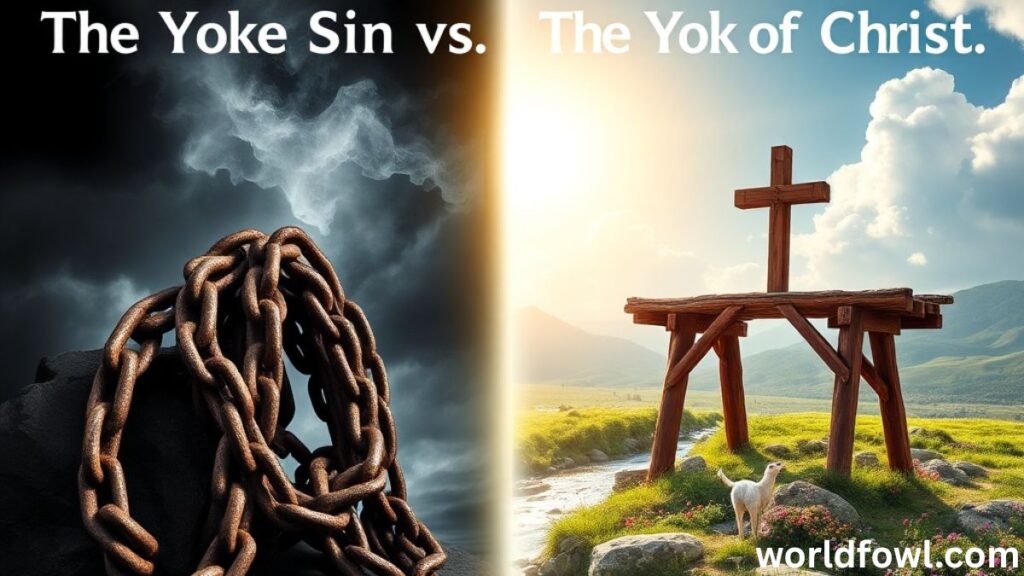
Christian doctrine presents humanity with a binary choice. You’ll wear a yoke either way—the question is which one.
The yoke of sin promises freedom but delivers slavery. It whispers, “Do what feels good. Follow your heart. You deserve happiness.” But these messages lead to spiritual bondage worse than any physical chains.
Romans 6:16 already established this: serving sin makes you sin’s slave. The progression accelerates. First, sin seems optional—a choice you control. Then it becomes habitual. Finally, it becomes compulsive, controlling you completely.
Consider various moral burden examples:
Pornography promises pleasure but delivers isolation, shame, and escalating addiction. The yoke grows heavier as you require more extreme content for the same effect.
Materialism promises security but delivers anxiety, debt, and endless craving. You accumulate possessions that possess you.
Bitterness promises justice but delivers poison that destroys you from within. You rehearse offenses constantly, wearing a yoke of resentment.
Pride promises significance but delivers loneliness and defensive posturing. You can’t admit weakness or ask for help.
Each sin fashions its own yoke—and unlike Jesus’ custom-fitted one, these chafe and wound. You weren’t designed to carry them. They contradict your created purpose.
The yoke of Christ operates completely differently. It aligns with your design. God created you for godly partnership with Him, so wearing His yoke feels right even when difficult.
Here’s the contrast in practical terms:
Financial decisions: Sin’s yoke says, “Spend everything now. You earned it.” Christ’s yoke says, “Live generously. Trust Me for provision.”
Relationships: Sin’s yoke says, What Is a Yoke in the Bible? “Use people for your benefit.” Christ’s yoke says, “Serve others as I served you.”
Work: Sin’s yoke says, “Achieve at any cost. Your worth equals your success.” Christ’s yoke says, “Work heartily as unto Me. Your worth is settled.”
The Yoke of Sin vs. The Yoke of Christ
Suffering: Sin’s yoke says, “This is meaningless. Escape through any means necessary.” Christ’s yoke says, “I’m working this for good. Trust Me.”
The yoke of Christ includes spiritual growth, moral integrity, and increasing faith alignment with God’s character. As you walk with Jesus, you become more like Him—not What Is a Yoke in the Bible? through striving, but through sustained partnership.
Case Study: Peter’s Transformation
Simon Peter exemplifies this exchange perfectly. Before meeting Jesus, he wore multiple yokes: professional anxiety as a struggling fisherman, religious inadequacy under Pharisaic standards, and impulsive temperament that caused constant problems.
Jesus called him to discipleship. Initially, Peter added Jesus’ yoke on top of his existing ones—trying to prove himself, earn approval, and achieve greatness through effort.
His spectacular failure (denying Jesus three times) finally shattered his self-reliance. After the resurrection, Jesus restored Peter not by lowering standards but by offering grace. Peter exchanged his yokes for Christ’s.
The transformed Peter wrote: “Cast all your anxiety on him because he cares for you” (1 Peter 5:7). He’d learned that spiritual freedom comes through surrender, not striving.
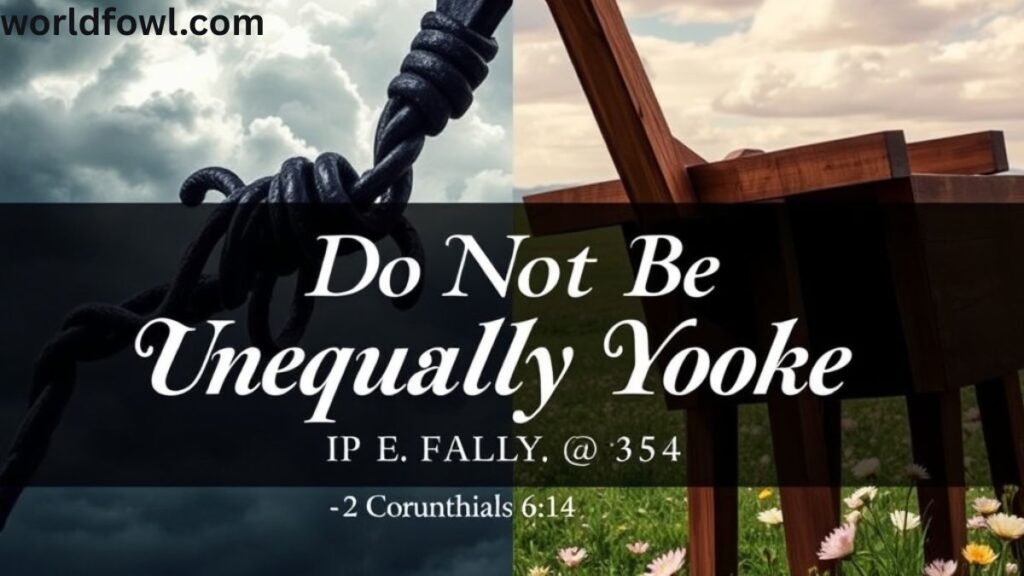
“Do Not Be Unequally Yoked” – 2 Corinthians 6:14
Paul’s warning in 2 Corinthians 6:14 extends yoke imagery into relational territory: “Do not be unequally yoked with unbelievers. For what partnership has righteousness with lawlessness? Or what fellowship has light with darkness?”
The biblical instruction here flows directly from agricultural reality. Farmers never yoked a powerful ox with a weak donkey. The animals had different sizes, strengths, and gaits. Yoking them together frustrated both and accomplished nothing productive.
Paul applies this to spiritual partnership between believers and unbelievers. The phrase “unequally yoked” doesn’t mean Christians should avoid all contact with non-Christians. Jesus ate with tax collectors and sinners constantly.
Instead, it addresses deep partnership and ethical partnership arrangements where both parties must pull in the same direction.
Where does this principle apply most directly?
Marriage represents the primary application. When Christian marriage guidance flows from this verse, it’s protecting both parties. Marriage yokes two people together for life. If one follows Christ and the other doesn’t, constant tension results.
This doesn’t mean such marriages can’t work—many do, especially when one spouse converts after marriage. But deliberately entering “unequally yoked relationships” courts predictable problems:
- Different ultimate authorities (God’s Word vs. personal preference)
- Conflicting values about money, sex, and child-rearing
- Divided loyalties regarding church involvement
- Spiritual isolation for the believing spouse
- Confusion for children about faith matters
Business partnerships also fit this principle. Yoking your financial future to someone whose moral alignment contradicts yours invites disaster. If your partner sees no problem with dishonesty, exploitation, or unethical practices, you’ll face constant moral compromise.
Close friendships can become unequally yoked too. While Christians should have non-Christian friends, your closest confidants—those who shape your thinking and influence your decisions—should share your faith alignment.
“Do Not Be Unequally Yoked” – 2 Corinthians 6:14
Ministry partnerships obviously require equal yoking. You can’t effectively advance Christ’s kingdom alongside someone who doesn’t acknowledge His lordship.
What “unequally yoked” does NOT mean:
- Christians can’t work for non-Christian employers
- Christians can’t have non-Christian neighbors or casual friends
- Christians must live in isolated religious bubbles
- Christians should treat non-Christians with suspicion or contempt
Paul’s concern centers on covenant relationship dynamics where two parties must pull together toward shared goals. When fundamental purposes clash, the yoke becomes oppressive for both parties.
Table: Equally vs. Unequally Yoked Relationships
| Relationship Type | Equally Yoked | Unequally Yoked |
|---|---|---|
| Marriage | Both submit to Christ’s lordship | Conflicting ultimate authorities |
| Business | Shared ethics and integrity | Different moral standards |
| Ministry | Unified vision and theology | Contradictory beliefs about God |
| Close friendship | Mutual spiritual encouragement | One pulls toward sin, other toward holiness |
Paul isn’t suggesting unbelievers have zero worth or that believers possess inherent superiority. He’s highlighting incompatible destinations. If one ox heads north and another south, the yoke tortures both.
Godly leadership in churches must apply this principle wisely. Some interpret it so strictly they create harmful isolation. Others ignore it entirely, leading to compromised witness and weakened faith.
The balance involves maintaining Christian living standards without becoming Pharisaical judges. Love non-Christians genuinely. Serve them sacrificially. But guard your deepest partnerships for those who share your spiritual direction.
Conclusion
Understanding What Is a Yoke in the Bible? helps us see how a simple tool can carry deep spiritual meaning.What Is a Yoke in the Bible? The Bible uses the yoke to show both heavy burdens and the gentle guidance God offers. It reminds us that people can live under pressures, harmful influences, or difficult responsibilities. But it also shows that God can break those burdens and lead His people with strength and care.
When we look at What Is a Yoke in the Bible?, we also see an invitation to walk closely with God. Jesus offers a yoke that brings rest, peace, and purpose. His teaching helps people move forward with lighter hearts and clearer direction.What Is a Yoke in the Bible? The yoke becomes a picture of partnership with Him, where we learn, grow, and find hope for everyday life.