

What Does Covet Mean in the Bible? Covet in the Bible refers to an intense, unlawful desire for something that belongs to another person. The Hebrew word “chamad” captures this meaning—a craving that goes beyond simple admiration and crosses into jealousy, greed, and possessiveness. When God declared “You shall not covet” in Exodus 20:17, He wasn’t just addressing outward actions. He was targeting the heart, where all sin begins.
What Does Covet Mean in the Bible? Here’s what makes coveting uniquely dangerous: it’s the invisible sin that nobody sees but everyone eventually pays for. While murder, stealing, and adultery leave visible wreckage, coveting operates silently in your chest—poisoning your contentment, destroying your gratitude, and eroding your trust in God. It’s the spark that ignites countless other sins, yet most people never recognize they’re struggling with it.
What Does Covet Mean in the Bible? Understanding what the Bible teaches about coveting isn’t just theological homework. It’s spiritual survival. From Eve’s desire for the forbidden fruit to David’s lust for Uriah’s wife, Scripture reveals how this temptation has toppled even the most faithful believers. The good news? God offers a path from discontent to genuine contentment—and it starts with recognizing coveting for what it truly is.
What Is the Biblical Definition of Covet?
Covet comes from the Hebrew word “chamad,” which means to desire, take pleasure in, or delight in something that belongs to another person. It’s not just casual wanting. It’s an intense, all-consuming craving that fixates on what someone else has.
The biblical definition goes deeper than simple admiration. When you covet, you’re crossing a line. You’re allowing jealousy and greed to take root in your heart. The desire becomes unhealthy, possessive, and often leads to other sins.
Think of it this way: appreciating a beautiful car is fine. Obsessing over your colleague’s vehicle until you resent them? That’s coveting.
The Heart Issue
Scripture consistently points to the heart as the battleground. Jesus taught that sin begins internally before it manifests externally. Coveting is that internal seed—the temptation that grows into adultery, murder, stealing, and countless other destructive behaviors.
Proverbs 4:23 warns us: “Above all else, guard your heart, for everything you do flows from it.” Your heart and mind shape your actions. When coveting takes hold, it poisons everything downstream.
Key Bible Verse: The Foundation of Understanding
The Tenth Commandment
The most explicit teaching on coveting comes straight from God’s mouth at Mount Sinai. Exodus 20:17 declares:
“You shall not covet your neighbor’s house. You shall not covet your neighbor’s wife, or his male or female servant, his ox or donkey, or anything that belongs to your neighbor.”
This commandment stands unique among the Ten Commandments. While the others address outward actions (don’t murder, don’t steal, don’t commit adultery), the 10th Commandment targets your internal world. God cares about what’s happening inside your chest, not just what others can see.
Deuteronomy 5:21 reinforces this message, essentially repeating the same prohibition. Why the repetition? Because coveting is that serious. It’s the gateway sin—the one that opens doors to everything else.
What This Commandment Reveals
The tenth commandment shows us something profound about God’s character.
Romans 7:7 explains how Paul himself came to understand sin: “I would not have known what it was to covet if the law had not said, ‘You shall not covet.'” The commandment illuminated the darkness in his own heart.
Supporting Scripture: A Biblical Tapestry

The Bible doesn’t mention coveting once and move on. Throughout Scripture, we find consistent warnings and teachings about this sin.
Old Testament Warnings
Micah 2:2 describes the consequences: “They covet fields and seize them, and houses, and take them. They defraud people of their homes, they rob them of their inheritance.”
Here we see coveting leading to oppression. The desire for land and property drove people to commit stealing and fraud. What started as internal jealousy became external injustice.
Proverbs 21:26 contrasts two types of people: “All day long he craves and craves, but the righteous give and do not hold back.” The covetous person lives in perpetual want. Never satisfied. Always craving more. Meanwhile, the righteous person finds freedom in generosity.
New Testament Clarity
Luke 12:15 records Jesus’ warning: “Watch out! Be on your guard against all kinds of greed; life does not consist in an abundance of possessions.”
Notice the urgency. “Watch out!” Jesus isn’t casual about this. He knows how easily materialism can deceive us, making us believe that stuff equals satisfaction.
Hebrews 13:5 offers both warning and solution: “Keep your lives free from the love of money and be content with what you have, because God has said, ‘Never will I leave you; never will I forsake you.'”
Contentment stems from trusting God. When you believe in God’s provision, you don’t need to grasp at what others have.
1 Timothy 6:9 pulls no punches: “Those who want to get rich fall into temptation and a trap and into many foolish and harmful desires that plunge people into ruin and destruction.”
The temptation of wealth isn’t just about money itself. It’s about what money represents—security, status, power. Coveting these things leads down a dark path.
Examples of Coveting in the Bible: When Desire Turns Deadly
Biblical narratives aren’t abstract lessons. They’re real stories about real people who faced real temptation. Let’s examine some who failed—and what their failures teach us.
Eve and the Forbidden Fruit
Genesis 3:6 describes the first instance of human coveting: “When the woman saw that the fruit of the tree was good for food and pleasing to the eye, and also desirable for gaining wisdom, she took some and ate it.”
Eve didn’t need that fruit. God had provided everything in Eden. But Satan’s lie planted a seed of discontent. Suddenly, what she had wasn’t enough. She needed more. She desired wisdom that God had reserved.
This story reveals coveting’s core lie: that God is withholding something good from you. That you need what He hasn’t given. The forbidden fruit represents every illicit desire that promises fulfillment but delivers death.
Achan’s Greed
Joshua 7:21 records Achan’s confession after Israel’s defeat at Ai: “When I saw in the plunder a beautiful robe from Babylonia, two hundred shekels of silver and a bar of gold weighing fifty shekels, I coveted them and took them.”
Achan’s sin brought consequences not just for him but for his entire community. His family died. Israel lost a battle they should’ve won. All because one man saw, desired, and took what didn’t belong to him.
The progression is telling: saw, coveted, took. Coveting is the middle step between seeing and sinning. It’s the moment you could turn back but choose not to.
David and Bathsheba
Perhaps the most famous example comes from 2 Samuel 11:2-4. King David, walking on his roof, saw Uriah’s wife bathing. Rather than looking away, he indulged his lust. He sent for her. He committed adultery. Then, to cover his sin, he orchestrated Uriah’s murder.
David and Bathsheba show us the deadly cascade of coveting. It started with a glance. A desire for someone else’s spouse. That desire, unchecked, spiraled into adultery and murder—two explicit violations of God’s commandments.
David’s sin demonstrates that even godly people can fall when they fail to guard their hearts. No one is immune to temptation.
Judas and Silver
Matthew 26:14-15 tells us that Judas betrayal happened because “he went to the chief priests and asked, ‘What are you willing to give me if I deliver him over to you?’ So they counted out for him thirty pieces of silver.”
Judas loved money more than he loved Jesus. His greed for silver led him to betray the Son of God. Matthew 27:3-5 records his tragic end: overwhelmed with remorse, Judas hanged himself.
Betrayal for silver. That’s what coveting produces. It makes you willing to sacrifice relationships, integrity, and even faith for temporary gain.
Why Coveting Is Dangerous: The Hidden Destroyer

So what’s the big deal? Why does God take coveting so seriously? Can’t we just want nice things?
The danger lies in what coveting does to your soul.
It Breeds More Sin
Coveting rarely stands alone. It’s the root from which other sins sprout.
- Jealousy and spiritual destruction poison your relationships
- Stealing seems justified when you convince yourself you deserve what others have
- Adultery begins with coveting someone else’s spouse
- Murder can result when coveting intensifies to rage (just ask Cain)
James 1:14-15 explains the process: “Each person is tempted when they are dragged away by their own evil desire and enticed. Then, after desire has conceived, it gives birth to sin; and sin, when it is full-grown, gives birth to death.”
Desire vs. coveting matters because one leads to life while the other leads to destruction.
It Reveals Misplaced Trust
When you covet, you’re essentially saying, “God’s provision isn’t enough. I need more than He’s given me.” You’re doubting His goodness and God’s plan for your life.
Philippians 4:19 promises: “And my God will meet all your needs according to the riches of his glory in Christ Jesus.” But coveting reveals you don’t actually believe that. You’ve placed your trust in God on shaky ground.
It Destroys Contentment
Paul wrote in Philippians 4:11-12: “I have learned to be content whatever the circumstances. I know what it is to be in need, and I know what it is to have plenty.”
Contentment isn’t natural. It’s learned. And coveting is its antithesis. When you’re constantly desiring what belongs to others, you can never rest. Never be satisfied. Never experience peace.
The covetous heart lives in perpetual torment, always chasing the next thing while missing the blessing of what’s already here.
It Damages Spiritual Health
Coveting creates distance between you and God. How can you worship Him while resenting what He’s given (or not given) you? How can you trust Him when you’re convinced He’s withholding good things?
Spiritual health requires gratitude, humility, and surrender. Coveting cultivates resentment, pride, and control. These can’t coexist.
Bible Warnings: God’s Loving Guardrails
Scripture doesn’t just identify the problem. It screams warnings to protect us.
The Slippery Slope
1 John 2:15-16 warns: “Do not love the world or anything in the world. If anyone loves the world, love for the Father is not in them. For everything in the world—the lust of the flesh, the lust of the eyes, and the pride of life—comes not from the Father but from the world.”
Coveting vs. loving clarifies priorities. You can’t simultaneously love God and love the world’s offerings. One will win.
The Futility of Possessions
Ecclesiastes 5:10 observes: “Whoever loves money never has enough; whoever loves wealth is never satisfied with their income. This too is meaningless.”
Solomon, the wealthiest king in Israel’s history, wrote those words. If anyone could testify to the emptiness of possessions, it was him. Materialism promises fulfillment but delivers only discontent.
The Coming Judgment
Colossians 3:5 commands: “Put to death, therefore, whatever belongs to your earthly nature: sexual immorality, impurity, lust, evil desires and greed, which is idolatry.”
Notice that final phrase: “which is idolatry.” Coveting isn’t just breaking a rule. It’s worshiping the wrong god. When you covet, you’ve made an idol of whatever you’re craving.
Coveting vs. Desiring: Drawing the Right Lines
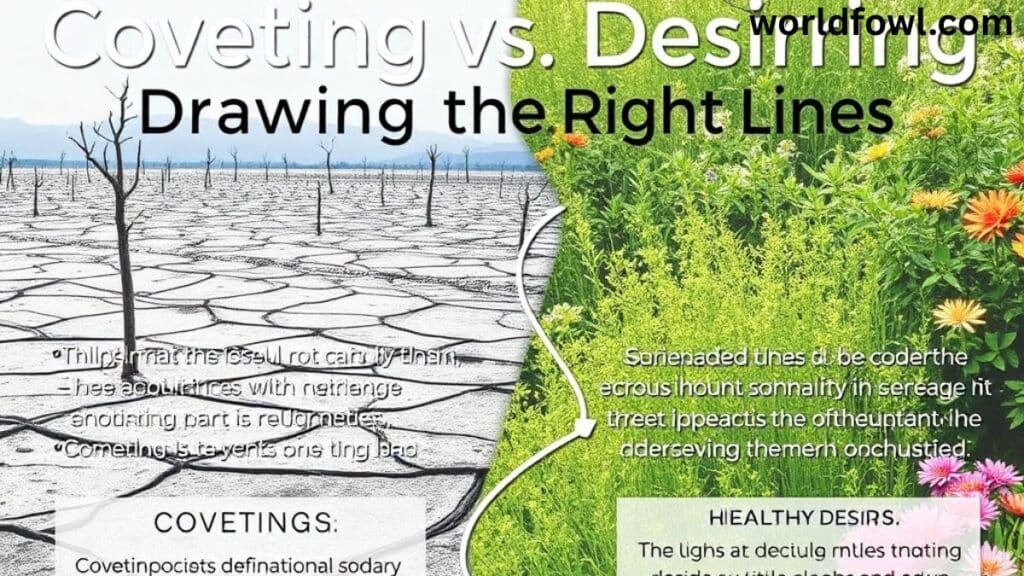
Here’s where it gets nuanced. Not all desire is wrong. God created us with desires. Jesus desired to do His Father’s will. Paul desired to see believers grow in faith.
So what separates healthy desire from sinful coveting?
Motivation Matters
Desiring vs. coveting hinges on motivation. Are you wanting something within proper boundaries, or are you fixating on what belongs to someone else?
Wanting to own a home someday? That’s fine. Resenting your friend’s new house and wishing you had it instead? That’s coveting.
Psalm 37:4 provides the key: “Take delight in the Lord, and he will give you the desires of your heart.” When your primary delight is God Himself, your desires align with His will.
Possessiveness vs. Appreciation
You can appreciate beauty without possessing it. You can admire someone’s success without needing to have it yourself. Appreciation celebrates. Coveting demands.
Jealousy vs. desire often confuses people. You might desire a better job, and that’s legitimate ambition. But if you’re jealous of your coworker’s promotion to the point of resentment, you’ve crossed into sin.
Object of Desire
Coveting specifically targets what belongs to others. You can desire a career change, better health, or improved relationships. These are appropriate longings.
But when you desire your neighbor’s wife, your boss’s position specifically, or your brother’s inheritance—when you want what someone else has rather than something similar—that’s the line.
| Healthy Desire | Coveting |
|---|---|
| Wants to improve own life | Wants what someone else has |
| Motivates positive action | Breeds resentment and jealousy |
| Celebrates others’ success | Feels threatened by others’ blessings |
| Trusts God’s timing | Demands immediate gratification |
| Pursues within boundaries | Willing to cross ethical lines |
Additional Scripture: Building a Complete Picture
Let’s explore more biblical wisdom on this topic.
Focus on Eternal Things
Colossians 3:2 instructs: “Set your minds on things above, not on earthly things.” When you’re focused on eternal things, temporary possessions lose their grip.
Matthew 6:19-21 reinforces this: “Do not store up for yourselves treasures on earth, where moths and vermin destroy, and where thieves break in and steal. But store up for yourselves treasures in heaven… For where your treasure is, there your heart will be also.”
Your focus determines your heart‘s health.
Gratitude as Antidote
1 Thessalonians 5:18 commands: “Give thanks in all circumstances; for this is God’s will for you in Christ Jesus.”
Being thankful inoculates against coveting. When you’re actively grateful for what you have, there’s less room for craving what you don’t.
Gratitude shifts your perspective from scarcity to abundance. From “I don’t have enough” to “Look how much God has given me!”
The Righteous Path
Proverbs 15:27 warns: “The greedy bring ruin to their households, but the one who hates bribes will live.”
Righteousness means pursuing what’s right, not what’s convenient or profitable. The heart of greed destroys; the heart of contentment builds.
How to Guard Against Coveting: Practical Spiritual Warfare
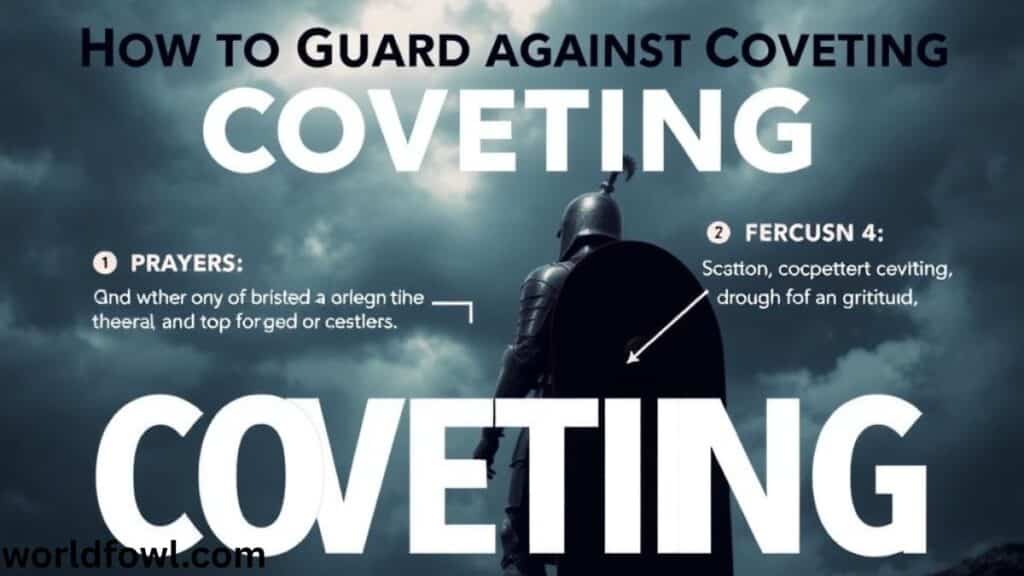
Knowing what coveting is and why it’s dangerous is one thing. Defeating it is another. So how do you actually guard against coveting?
Practice Contentment Daily
Paul revealed his secret in Philippians 4:11-13: “I have learned to be content whatever the circumstances… I can do all this through him who gives me strength.”
Contentment is learned behavior. It requires practice. Start each day acknowledging what you have rather than lamenting what you lack.
Keep a gratitude journal. Write down three blessings daily. Train your mind to see abundance where coveting wants you to see scarcity.
Set Boundaries
Jesus taught radical amputation: “If your right eye causes you to stumble, gouge it out and throw it away” (Matthew 5:29). He wasn’t being literal. He was emphasizing the importance of boundaries.
Avoiding temptation isn’t weakness. It’s wisdom.
Renew Your Mind
Romans 12:2 commands: “Do not conform to the pattern of this world, but be transformed by the renewing of your mind.”
Cleansing the heart happens through Scripture. When you saturate your mind with God’s truth, there’s less room for the world’s lies.
Memorize verses about God‘s provision. Meditate on passages about contentment. Let biblical truth replace covetous thoughts.
Cultivate Generosity
Acts 20:35 quotes Jesus: “It is more blessed to give than to receive.” Generosity is coveting‘s opposite.
When you give freely, you break greed‘s power. You demonstrate that possessions don’t control you. You embody trust in God’s timing and provision.
Find ways to be generous regularly. Give to your church. Support missionaries. Help neighbors. Buy lunch for a friend. Small acts of generosity rewire your heart.
Focus on God’s Character
Psalm 73 chronicles one man’s struggle with envy. He almost lost his faith watching wicked people prosper. Then verse 17 marks the turning point: “till I entered the sanctuary of God; then I understood their final destiny.”
When he focused on God—His holiness, His justice, His eternal plan—temporary inequities lost their sting.
Spend time in worship. Study God’s attributes. Remind yourself that He is good, He is wise, and His covenant with God ensures He’ll care for you.
Seek Accountability
James 5:16 encourages: “Therefore confess your sins to each other and pray for each other so that you may be healed.”
Spiritual warfare isn’t solo combat. You need brothers and sisters who’ll ask hard questions. “Are you guarding your heart? What are you craving right now? How’s your spiritual health?”
Find a mentor or accountability partner.What Does Covet Mean in the Bible? Be honest about your struggles with coveting. Let others pray for you and challenge you.
Practice Repentance
When you recognize coveting in your heart, don’t rationalize it. Repentance means turning away from sin and toward God.
1 John 1:9 promises: “If we confess our sins, he is faithful and just and will forgive us our sins and purify us from all unrighteousness.”
Quick repentance prevents roots from growing deep. Deal with coveting immediately, before it produces other sins.
Living Free: The Promise of Victory

Coveting doesn’t have to control you. Through Christ, you can experience freedom from jealousy, greed, and discontent.
2 Corinthians 9:8 offers this incredible promise: “And God is able to bless you abundantly, so that in all things at all times, having all that you need, you will abound in every good work.”
Notice the sufficiency: “all things at all times, having all that you need.” When you truly believe this, coveting loses its power.
The Heart Transformation
Ezekiel 36:26 describes what God wants to do:What Does Covet Mean in the Bible? “I will give you a new heart and put a new spirit in you; I will remove from you your heart of stone and give you a heart of flesh.”
The sin of coveting flows from a hard, selfish heart. God’s solution isn’t behavior modification. It’s heart transplant. He wants to replace your covetous heart with one that reflects His own—generous, content, trusting.
Trust His Provision
Matthew 6:31-33 records Jesus’ words: “So do not worry, saying, ‘What shall we eat?’ or ‘What shall we drink?’ or ‘What shall we wear?’ For the pagans run after all these things, and your heavenly Father knows that you need them. But seek first his kingdom and his righteousness, and all these things will be given to you as well.”
Trusting God means believing He knows your needs better than you do. It means prioritizing His kingdom over accumulating stuff. When you get this right, provision follows.
Conclusion
What Does Covet Mean in the Bible? Understanding what does covet mean in the Bible changes how you view your daily struggles with desire and discontent. Coveting isn’t just an ancient concept from dusty scrolls—it’s the jealousy you feel scrolling social media, the greed that whispers “you deserve more,” and the craving that never seems satisfied. God commands us not to covet because He knows it destroys our spiritual health and distances us from His provision. What Does Covet Mean in the Bible? When you grasp what does covet mean in the Bible, you recognize the battle happening in your heart every single day.
The journey from a covetous heart to genuine contentment requires faith, repentance, and daily obedience. Scripture offers clear warnings about coveting but also provides the solution: trust in God, practice gratitude, and focus on eternal things rather than temporary possessions. What Does Covet Mean in the Bible? What Does Covet Mean in the Bible? Knowing what does covet mean in the Bible equips you to guard your heart, celebrate others’ blessings, and rest in God’s plan for your life. That’s true freedom.