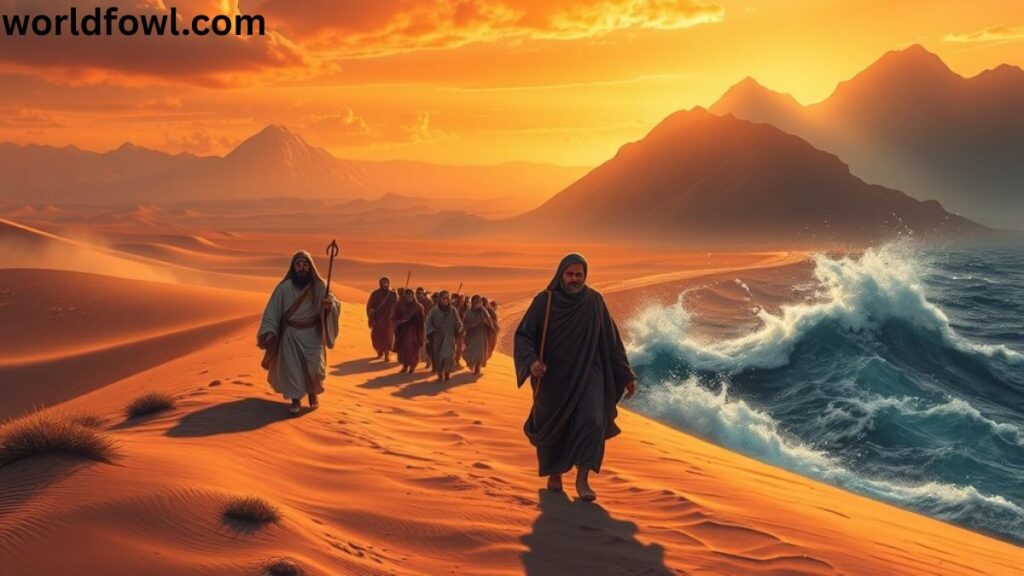
The meaning of Exodus in the Bible centers on divine deliverance and covenant formation. This second book of the Old Testament chronicles how God liberated the Israelites from brutal slavery in Egypt, transforming them from an oppressed people into a holy nation. The narrative showcases God’s faithfulness to His promises while establishing foundational principles for worship, justice, and relationship with the Divine.
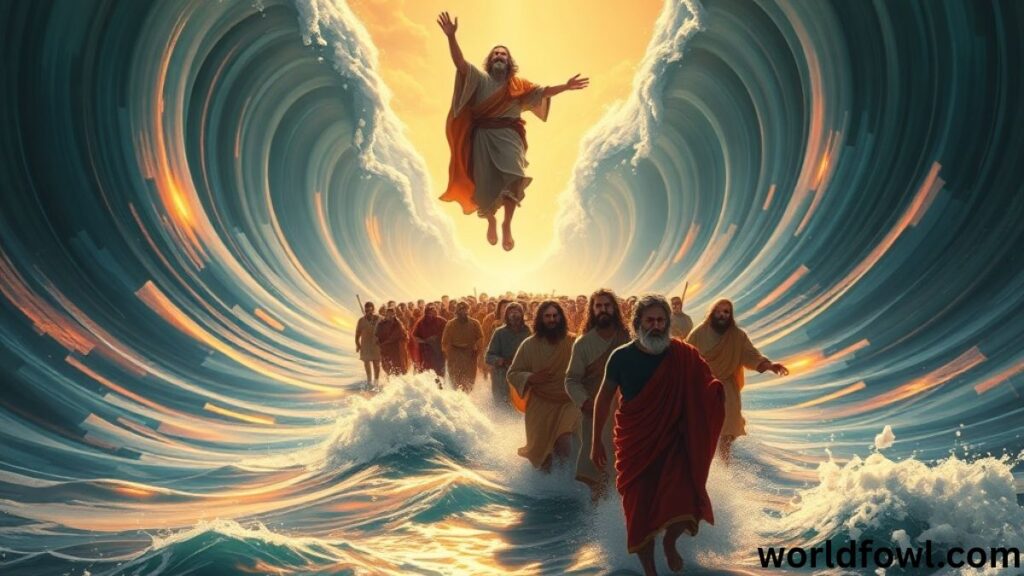
Picture this: an entire nation walks between walls of water on dry ground while their former oppressors drown behind them. The parting of the Red Sea isn’t just spectacular cinema—it’s the watershed moment when powerless slaves became God’s chosen people. Moses leads. Pharaoh pursues. Then everything changes in one miraculous night.
The Book of Exodus delivers more than historical drama. It reveals patterns of redemption repeated throughout Scripture, culminating in Jesus Christ. From the Passover Lamb to the covenant at Mount Sinai, every element points toward humanity’s desperate need for a deliverer and God’s passionate commitment to provide one.
What Is the Book of Exodus About?

Exodus means “exit” or “departure” in Greek. The Hebrew title, Shemot, translates to “names”—taken from the opening phrase “These are the names.” Both titles capture something essential about this second book of the Old Testament.
The narrative picks up where Genesis ends. Jacob’s family has multiplied in Egypt. But a new Pharaoh rises who doesn’t remember Joseph’s contributions. Fear grips his heart. He enslaves the Israelites, forcing them into brutal labor building cities and monuments.
Slavery in Egypt becomes unbearable. Babies are murdered. Hope seems crushed. Yet God’s faithfulness doesn’t waver.
Enter Moses—a Hebrew child rescued from death, raised in Pharaoh’s palace, later exiled to the wilderness. God appears to him in a burning bush and issues a staggering command: confront the most powerful ruler on earth and demand the release of an entire enslaved nation.
What follows is nothing short of miraculous. Ten Plagues devastate Egypt. The Passover marks Israel’s households for protection. The Red Sea parts dramatically, allowing the Israelites to escape while Pharaoh’s army drowns behind them.
But physical freedom from slavery is only the beginning. At Mount Sinai, God establishes a covenant relationship with His chosen people. He gives them the Ten Commandments and detailed instructions for building the Tabernacle—a sacred space where God’s presence would dwell among them.
The book concludes with the completion of the Tabernacle. God’s glory fills it. The wilderness journey ahead won’t be easy, but God will lead His people every step.
Key Sections of Exodus
Understanding Exodus requires breaking it into its major movements. Each section reveals crucial aspects of God’s character and His relationship with humanity.
Israel’s Enslavement (Exodus 1-2)
The opening chapters paint a grim picture. The Israelites multiply despite oppression. Pharaoh orders Hebrew boys drowned in the Nile. Moses’ mother hides him for three months before placing him in a waterproof basket among the reeds.
Pharaoh’s daughter discovers the child. She adopts him. Ironically, the very palace that ordered his death becomes his home. Moses grows up with privilege and education, yet he never forgets his Hebrew identity.
When Moses witnesses an Egyptian beating a Hebrew slave, rage overcomes him. He kills the Egyptian and flees to Midian. There he marries, tends sheep, and seemingly disappears from history.
But God hasn’t forgotten His promises to Abraham, Isaac, and Jacob.
God’s Call to Moses (Exodus 3-4)
Four decades pass. Then fire appears in a desert bush—fire that burns but doesn’t consume. God’s call shatters Moses’ quiet shepherd life.So I have come down to rescue them.”
Moses protests. He’s not eloquent. He’s a fugitive. Who will believe him?
God responds with patience and power. He reveals His sacred name: I AM WHO I AM. He performs signs—Moses’ staff becomes a serpent, his hand turns leprous and heals again. God promises His brother Aaron will speak for him.
Reluctantly, Moses returns to Egypt to begin the greatest liberation mission in biblical history.
The Ten Plagues and Passover (Exodus 7-12)
Pharaoh’s heart proves stubborn. Despite repeated warnings, he refuses to release Israel. So God unleashes Ten Plagues that systematically dismantle Egypt’s power and expose its gods as impotent.
Water turns to blood. Frogs swarm. Gnats infest. Flies plague. Livestock die. Boils erupt. Hail destroys. Locusts devour. Darkness descends.
Each plague demonstrates God’s sovereignty over nature and nations. Egypt’s magicians initially replicate some signs, but eventually they’re forced to admit: “This is the finger of God.”
The final plague strikes deepest. God announces that every firstborn in Egypt will die—from Pharaoh’s heir to the firstborn of livestock. Only households marked with lamb’s blood on their doorposts will be spared.
The Passover becomes a defining moment. Israel must trust God’s protection completely. They must obey explicitly. When death sweeps through Egypt that night, the Angel of the Lord “passes over” homes marked by blood.
Pharaoh finally breaks. “Go!” he cries. “Worship the LORD as you have requested.”
Crossing the Red Sea (Exodus 14)
Freedom tastes sweet—but brief. Pharaoh regrets his decision. He mobilizes his army and pursues the fleeing slaves.
Trapped between Pharaoh’s army and the Red Sea, the Israelites panic. They accuse Moses of leading them to their deaths. But Moses delivers one of Scripture’s most powerful declarations:
“Do not be afraid. Stand firm and you will see the deliverance the LORD will bring you today” (Exodus 14:14).
God commands Moses to raise his staff. All night, a powerful wind blows. The sea splits. Walls of water stand on both sides as Israel crosses on dry ground.
When Egypt’s chariots follow, God releases the waters. The entire army drowns. Not one pursuer survives.
The crossing of the Red Sea represents the ultimate point of no return. Egypt’s power is shattered. Israel’s identity as God’s redeemed people is sealed.
The Covenant at Mount Sinai (Exodus 19-24)
Three months after leaving Egypt, Israel camps at Mount Sinai. This mountain becomes the birthplace of a nation.
God proposes a covenant: “If you obey me fully and keep my covenant, then out of all nations you will be my treasured possession.”
The people respond unanimously: “We will do everything the LORD has said.”
Thunder rolls. Lightning flashes. Trumpet blasts shake the mountain. God descends in fire. The ground trembles. The people stand in awe and terror.
Then God speaks the Ten Commandments—foundational principles that will govern this new nation. These laws cover relationship with God and relationships among people. They establish boundaries for worship, family life, property, and justice.
But the Law extends far beyond ten statements. God’s law includes detailed regulations about social justice, worship practices, festivals, and moral behavior. These instructions reveal God’s character: holy, just, merciful, and deeply concerned with how His people treat one another.
The Tabernacle (Exodus 25-40)
The final section focuses on something extraordinary: detailed plans for the Tabernacle, a portable sanctuary where God Himself will dwell among His people.
The instructions are meticulous. Gold, silver, and bronze. Blue, purple, and scarlet yarn. Fine linen and animal skins. Acacia wood and precious stones. Every material matters. Every measurement counts.
The Tabernacle in the wilderness serves multiple purposes:
- Visual reminder of God’s presence
- Sacred space for worship
- Center of community life
- Symbol of God’s desire to dwell with humanity
When construction finishes, something astonishing happens. The cloud that led Israel through the desert descends. God’s glory fills the Tabernacle so completely that even Moses cannot enter.
From that moment forward, God’s visible presence guides Israel. When the cloud lifts, they travel. When it settles, they camp.
Themes in the Book of Exodus

The Book of Exodus weaves together multiple theological threads. These themes don’t just inform ancient Israel—they illuminate truth for all generations.
Deliverance and Redemption
The central theme pulses through every chapter: God rescues His people.
Israel didn’t save themselves. They couldn’t overthrow their oppressors through military might. They didn’t possess the resources or strategy for escape from Egypt. Their deliverance came entirely from divine intervention.
This pattern of divine deliverance establishes a template repeated throughout Scripture. God sees suffering. The He hears cries. He acts decisively. He liberates completely.
The Exodus from Egypt demonstrates that redemption from bondage requires a redeemer more powerful than the oppressor. Pharaoh commanded the mightiest empire on earth, but God’s authority transcends all earthly power.
Biblical salvation theme always points to this truth: we cannot free ourselves from what enslaves us. We need someone stronger to break our chains.
God’s Covenant Faithfulness
Before Moses was born, God made promises to Israel. He swore oaths to Abraham, Isaac, and Jacob. He declared their descendants would become a great nation.
Centuries passed. Circumstances looked bleak. Yet God’s faithfulness never wavered.
The covenant at Mount Sinai formalized this relationship. God bound Himself to Israel. He declared them His treasured possession. He offered protection, guidance, and His own presence.
But this covenant relationship also demanded response. Israel must obey God’s law. They must worship Him exclusively. They must reflect His character in their dealings with one another.
God’s promises to Israel weren’t conditional on their perfection—they would fail repeatedly. But the covenant did require ongoing faithfulness, repentance when they strayed, and commitment to the relationship.
This theme reveals something beautiful about God’s nature
God’s Power and Sovereignty
The Ten Plagues of Egypt systematically displayed divine authority. Each plague targeted specific Egyptian deities, proving them powerless before the true God.
The Nile turned to blood—a judgment against Hapi, the Nile god. Frogs overwhelmed Egypt—mocking Heqet, the frog goddess of fertility. Darkness covered the land—demonstrating the impotence of Ra, the sun god.
God’s power also controlled nature itself
God’s sovereignty extended beyond natural forces to human affairs. He hardened Pharaoh’s heart to accomplish His purposes. He orchestrated events to maximize His glory and Israel’s faith.
This theme confronts a crucial question: who really rules? Political powers seem mighty. Natural forces appear unstoppable. But God alone possesses absolute authority.
Obedience and Worship
Worship in Exodus isn’t merely singing songs. It encompasses total life orientation toward God.
The detailed instructions for the Tabernacle, priestly garments, sacrifices, and festivals demonstrate that worship matters profoundly to God. How we approach Him, what we bring, our attitudes and actions—everything counts.
Obedience to God flows from worship. Israel must follow regulations about justice because God is just. They must show mercy because God is merciful. They must maintain holiness because God is holy.
The Ten Commandments establish foundational principles for both vertical relationship (with God) and horizontal relationships (with others). You cannot genuinely worship God while oppressing your neighbor.
Worship practices in Exodus include:
| Practice | Purpose | Scripture |
|---|---|---|
| Sabbath observance | Rest and remembrance | Exodus 20:8-11 |
| Passover celebration | Memorial of deliverance | Exodus 12:14-20 |
| Daily sacrifices | Atonement and dedication | Exodus 29:38-46 |
| Tabernacle construction | Sacred space for God’s presence | Exodus 25-31 |
| Priestly ministry | Mediation between God and people | Exodus 28-29 |
These practices taught Israel essential truths about approaching a holy God. They couldn’t waltz casually into His presence. They needed cleansing, sacrifice, and proper mediation.
The Spiritual Meaning of Exodus
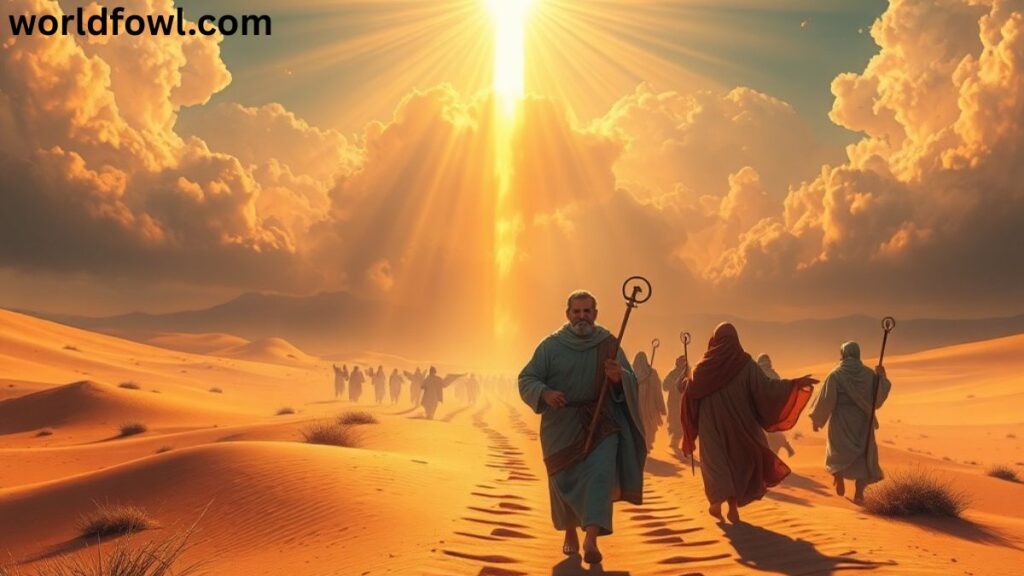
Beyond historical narrative, Exodus carries profound spiritual significance that transcends time and culture.
The Exodus represents more than one nation’s liberation. It pictures humanity’s universal condition: enslaved to forces we cannot overcome alone, desperate for a deliverer, needing redemption that comes from outside ourselves.
Egypt as bondage symbolizes any system, power, or circumstance that oppresses and imprisons. For ancient Israel, it was literal slavery. For us today, it might represent:
- Sin that enslaves our will
- Addictions that control behavior
- Toxic relationships that trap
- Unjust systems that oppress
- Fear that paralyzes
- Shame that imprisons
The wilderness journey after liberation illustrates another reality: freedom doesn’t mean instant maturity. Israel faced challenges, complained frequently, and often longed to return to Egypt despite its cruelty. Familiar bondage felt safer than uncertain freedom.
Similarly, spiritual freedom requires perseverance. Growth happens gradually. Trust must be cultivated. Old patterns don’t disappear overnight.
The Tabernacle speaks to God’s passionate desire for intimacy with His people. He doesn’t merely rescue then abandon us. He journeys with us, provides guidance, and offers His presence as our ultimate treasure.
Parallels Between Exodus and the Gospel
Christian theology sees remarkable connections between the Exodus narrative and Jesus Christ.
Moses and Jesus share striking similarities:
- Both experienced threatened childhoods
- Both spent time in exile
- Both received divine commissions
- Both delivered God’s people
- Both mediated covenants
- Both revealed God’s character
Yet Hebrews 3:3 declares Jesus “worthy of greater honor than Moses.” While Moses led Israel from physical slavery, Jesus liberates humanity from sin itself. He’s the “greater Moses” who accomplishes ultimate redemption.
The Passover Lamb points directly to Christ. John the Baptist identified Jesus as “the Lamb of God who takes away the sin of the world” (John 1:29). Just as lamb’s blood protected Israelite homes from judgment, Christ’s blood provides protection from spiritual death.
The crossing of the Red Sea parallels baptism. Paul writes that Israel was “baptized into Moses in the cloud and in the sea” (1 Corinthians 10:2). Baptism symbolizes dying to the old life and rising to new life—just as Israel’s old existence ended at the sea and new identity began.
God’s presence in the Tabernacle foreshadows incarnation. John writes that Jesus “made his dwelling among us” (John 1:14)—literally “tabernacled” with humanity. God no longer dwells in a tent but took on human flesh.
These Gospel parallels reveal Scripture’s unified message: God actively pursues human redemption. From biblical Exodus explanation through Christ’s work, the story remains consistent—God delivers His people.
Relevance of Exodus Today

Why should modern readers care about events from over 3,000 years ago?
Because the Book of Exodus addresses timeless human needs and reveals an unchanging God.
Hope in adversity speaks powerfully today. When circumstances feel overwhelming, when oppression seems unbreakable, when darkness appears permanent—the Exodus reminds us that God sees, hears, and acts. He specializes in impossible situations.
Justice and freedom in the Bible inspire movements worldwide. The Exodus narrative has fueled liberation theology, civil rights activism, and efforts to combat modern slavery. When God declared “Let my people go,” He established that human dignity and freedom matter profoundly to Him.
Social justice symbolism
throughout Exodus challenges believers to care about oppression, inequality, and systemic injustice. God didn’t merely save Israel spiritually—He addressed their physical suffering and social condition. Biblical faith must engage both.
Trust in God during uncertain journeys remains essential. Like Israel in the wilderness, we often face unclear paths. We doubt God’s provision. We’re tempted to retreat to familiar but unhealthy patterns. Exodus teaches us that God’s guidance proves faithful even when we can’t see the entire route ahead.
Faith in times of hardship gets tested repeatedly. Israel questioned God after every difficulty. Yet He remained patient, continued providing, and never abandoned them. Our doubts don’t disqualify us from His love.
Moral guidance from the Ten Commandments and additional laws still instructs. While some regulations applied specifically to ancient Israel’s context, underlying principles—honoring God, valuing human life, maintaining sexual integrity, speaking truth, respecting property—remain vital.
Spiritual growth parallels Israel’s journey. We’re called out of bondage, must learn to trust God’s provision, and gradually mature into people who reflect His character. The process takes time. Setbacks happen. But God remains committed to completing what He started.
Contemporary applications include:
- Personal freedom: recognizing areas where you remain enslaved and seeking God’s deliverance
- Community identity: understanding what it means to be God’s people set apart
- Worship priorities: evaluating whether your life truly centers on God
- Justice work: advocating for the oppressed and vulnerable
- Covenant faithfulness: maintaining committed relationship with God through challenges
- Hope cultivation: remembering God’s past faithfulness to fuel trust for the future
Bible Verses to Reflect On
Let these powerful passages from Exodus sink deep into your heart:
God’s awareness of suffering:
“I have indeed seen the misery of my people in Egypt. I have heard them crying out because of their slave drivers, and I am concerned about their suffering. So I have come down to rescue them from the hand of the Egyptians.” — Exodus 3:7-8
trusting God during crisis:
“The LORD will fight for you; you need only to be still.” — Exodus 14:14
God’s self-revelation:
“I am the LORD your God, who brought you out of Egypt, out of the land of slavery.” — Exodus 20:1-2
God’s compassionate character:
“The LORD, the LORD, the compassionate and gracious God, slow to anger, abounding in love and faithfulness, maintaining love to thousands, and forgiving wickedness, rebellion and sin.” — Exodus 34:6-7
the purpose of redemption:
“Then have them make a sanctuary for me, and I will dwell among them.” — Exodus 25:8
These verses capture the heart of Exodus: a God who sees suffering, intervenes powerfully, establishes relationship, and desires to dwell with His people.
Conclusion
The meaning of Exodus in the Bible transcends ancient history. It speaks directly to your life today. This powerful narrative reveals a God who sees suffering, hears desperate cries, and acts decisively. Moses led the Israelites from bondage to freedom, but the deeper message points to spiritual deliverance we all desperately need. Every chapter demonstrates God’s faithfulness even when circumstances look impossible.
The meaning of Exodus in the Bible ultimately points toward Jesus Christ. He’s the greater deliverer who breaks chains that enslave souls. The Passover Lamb foreshadows His sacrifice. The Red Sea crossing pictures baptism into new life. The covenant at Mount Sinai finds fulfillment in Christ’s work. Whether you’re trapped in personal bondage or wandering through wilderness seasons, Exodus offers profound hope. God still rescues. He still transforms. He still keeps His promises. That’s the enduring power of this remarkable biblical book.