
15 Interesting Facts About Sarah from the Bible unveil the remarkable journey of one of Scripture’s most influential women—a matriarch whose story shaped the foundation of three major world religions.15 Interesting Facts About Sarah from the Bible These compelling details about Sarah go far beyond her role as Abraham’s wife, revealing a complex woman who wrestled with faith, experienced decades of infertility, and ultimately became the Mother of nations through God’s miraculous intervention.
15 Interesting Facts About Sarah from the Bible Most people know she laughed at God’s promise of a child. But did you know she was renamed by God Himself, that her beauty captivated kings even in her eighties, or that she’s one of only two women individually honored in Hebrews 11’s Hall of Faith? Her burial site became the first piece of the Promised Land that Abraham actually owned—a purchase that established biblical roots stretching to this day.
15 Interesting Facts About Sarah from the Bible Sarah’s life wasn’t a smooth path of unwavering faith. She made mistakes, doubted divine promises, and took matters into her own hands with Hagar. Yet her story demonstrates how God works through imperfect people to accomplish His perfect covenant purposes, making her journey profoundly relatable and deeply inspiring for modern believers facing their own impossible circumstances.
Her Name Was Originally Sarai
Sarai means “my princess” in Hebrew—a beautiful name, but limited in scope. When God established His covenant with Abraham, He didn’t just change one name. He transformed both of them.
God renamed her Sarah, which means “princess” without the possessive modifier. This wasn’t a minor edit. It represented a fundamental shift in her identity and destiny. She wasn’t just Abraham’s princess anymore. She would become royalty for all nations.
Biblical name changes always signify profound transformation. Jacob became Israel. Simon became Peter. These weren’t casual rebrands—they marked pivotal moments in God’s plan.
The name change occurred when Sarah was 89 years old, according to Genesis 17:15. At an age when most would consider their life’s trajectory set, God was just getting started with Sarah. He promised that she would bear a son and that “kings of peoples shall come from her.”
Think about that for a moment. Sarah had spent decades defined by her relationship to Abraham. Now God was declaring she had independent significance in His redemptive story. Women in the Bible often get overlooked, but Sarah’s name change shows her crucial role.
What This Reveals About God’s Character
God’s covenant promise included Sarah from the beginning. He didn’t view her as merely Abraham’s appendage. She had her own calling, her own purpose, her own relationship with the divine.
This matters because it establishes that God values women as autonomous individuals in His plan. Sarah wasn’t just along for the ride—she was driving part of the journey herself.
She Was Abraham’s Half-Sister
Here’s where things get complicated. Sarah and Abraham shared the same father but had different mothers. Genesis 20:12 confirms this unusual relationship when Abraham admits it to Abimelek, King of Gerar.
Ancient Near Eastern customs differed vastly from modern sensibilities. Marriage between half-siblings wasn’t uncommon in that cultural context. Still, this fact surprises many readers when they discover it.
The relationship became problematic not because of the familial connection but because of Abraham’s deception. Twice he introduced Sarah as merely his sister—to Pharaoh of Egypt in Genesis 12 and to Abimelek in Genesis 20.
| Incident | Location | Ruler Deceived | Consequence |
|---|---|---|---|
| First deception | Egypt | Pharaoh | Plagues on Pharaoh’s household |
| Second deception | Gerar | Abimelek | God warned Abimelek in a dream |
Abraham’s fear-driven lies put Sarah in vulnerable positions. Both rulers took her into their households, intending to marry her. Yet God’s miraculous intervention protected her both times.
The Deeper Issue
These incidents reveal Sarah’s remarkable beauty and Abraham’s struggle with trusting God’s timing. If Abraham died, God’s promise died with him—or so Abraham thought. His protective instincts overrode his faith.
Sarah went along with the deception, showing the complexity of their relationship
She Was Known for Her Beauty

Sarah’s beauty wasn’t just mentioned casually. Scripture emphasizes it repeatedly, even when she reached advanced age. Genesis 12:11 records Abraham saying, “I know that you are a woman beautiful in appearance.”
This statement came as they approached Egypt, when Sarah was 65 years old. Later, at 89, King Abimelek of Gerar found her desirable enough to take her into his household. Clearly, she possessed extraordinary beauty that defied time.
First Peter 3:3-6 holds up Sarah as an example of true beauty—not just physical appearance but “the hidden person of the heart with the imperishable beauty of a gentle and quiet spirit.” The passage specifically names her as a model for women who hope in God.
Ancient texts outside Scripture also reference Sarah’s legendary beauty. The Genesis Apocryphon, a Dead Sea Scroll document, describes her features in elaborate detail:
Beauty as Both Blessing and Burden
Sarah’s appearance opened doors but also created complications. It attracted the attention of powerful men, forcing her into dangerous situations through no fault of her own. Her story reminds us that beauty exists in complex contexts.
Yet her inclusion in Hebrews 11, the Hall of Faith, rests entirely on her spiritual qualities. Her faith-based obedience mattered more than her physical attributes in God’s economy.
She Laughed at God’s Promise
This moment is both humorous and deeply human. Three visitors came to Abraham’s tent near the oaks of Mamre. One was the Lord Himself. They promised that Sarah would have a son within the year.
Sarah was eavesdropping from the tent entrance. When she heard this promise, Genesis 18:12 records her reaction: “So Sarah laughed to herself, saying, ‘After I am worn out, and my lord is old, shall I have pleasure?'”
Her laughter wasn’t joyful. It was the bitter laugh of someone who’d given up hope. She was 89. Abraham was 99. Biology made the promise seem absurd.
God heard her laugh and questioned Abraham about it. Sarah got scared and lied, saying “I did not laugh.” But God replied, “No, but you did laugh.”
The Name Isaac Means “He Laughs”
Here’s the beautiful irony. When the promised son arrived, they named him Isaac, which literally means “he laughs” or “laughter.” What began as skeptical laughter transformed into joyful laughter.
God took Sarah’s moment of doubt and redeemed it completely. Every time she called her son’s name, she remembered both her faithlessness and God’s faithfulness. The name became a permanent testimony.
This illustrates God’s sovereignty perfectly. He doesn’t abandon us when we doubt. He works through our weakness to display His strength. Sarah’s struggle with belief didn’t disqualify her—it humanized her story.
15 Interesting Facts About Sarah from the BibleTrusting God despite doubt is possible. Sarah proves it. Her initial skepticism didn’t prevent God’s plan from unfolding exactly as promised.
She Waited Decades for a Child

The timeline is staggering. God first promised Abraham descendants in Genesis 12, when Abraham was 75. Isaac wasn’t born until Abraham was 100—a 25-year wait.
Sarah’s infertility defined much of her adult life. In ancient culture, childlessness brought shame and social stigma. A woman’s value was often measured by her ability to produce heirs, especially sons.
Genesis 11:30 states the painful reality plainly: “Now Sarai was barren; she had no child.” This wasn’t a temporary condition or a delayed blessing—it was a medical fact in a world without fertility treatments.
The Emotional Toll
Imagine watching your friends, relatives, and neighbors have children while you remain childless year after year. That was Sarah’s reality. The promise of descendants must have felt increasingly cruel as time passed.
15 Interesting Facts About Sarah from the Bible She went through phases that anyone struggling with infertility in the Bible would recognize:
- Hope: Initially believing God’s promise would come soon
- Desperation: Taking matters into her own hands with Hagar
- Bitterness: Laughing cynically at the idea of pregnancy
- Resignation: Accepting her childless state as permanent
- Shock: Discovering she was actually pregnant at 90
Her decades of waiting on God weren’t passive. She actively wrestled with the promise, doubted it, tried to fulfill it her own way, and eventually received it when she’d given up.
Biblical lessons on faith often gloss over the messy middle. Sarah’s story doesn’t. It shows that spiritual resilience develops through prolonged testing, not instant miracles.
She Gave Hagar to Abraham
This decision haunts Sarah’s story. After years of childlessness, she proposed a solution that seemed practical by ancient standards. Genesis 16:2 records her words to Abraham: “Behold now, the Lord has prevented me from bearing children. Go in to my servant; it may be that I shall obtain children by her.”
Hagar, Sarah’s Egyptian servant, became a surrogate. This practice was legally acceptable in ancient Mesopotamian culture, as documented in archaeological texts like the Code of Hammurabi.
When Hagar conceived, the household dynamics shifted disastrously. Genesis 16:4 says that Hagar “looked with contempt on her mistress.” Sarah responded harshly, and Hagar fled into the wilderness.
The Ishmael Complication
Hagar’s son Ishmael became a permanent reminder of Sarah’s attempt to force God’s promise on her own timeline. Abraham was 86 when Ishmael was born—still 14 years before Isaac’s arrival.
Sarah’s plan created ongoing family tension. Two sons, two mothers, one household. The situation couldn’t last.
Genesis 21:9-10 describes the breaking point. Sarah saw Ishmael mocking young Isaac and demanded Abraham send Hagar and Ishmael away: “Cast out this slave woman with her son, for the son of this slave woman shall not be heir with my son Isaac.”
This sounds cruel to modern ears. Abraham was distressed—Ishmael was his son too. But God told Abraham to listen to Sarah because “through Isaac shall your offspring be named.”
What This Teaches About Control
15 Interesting Facts About Sarah from the Bible Sarah’s mistake was trying to manufacture God’s plan through human effort. She couldn’t wait for God’s timing, so she created her own solution. The consequences rippled through generations.
Obedience to God sometimes means doing nothing—just waiting. Sarah had to learn that God’s divine timing supersedes our impatience. The fulfillment of God’s promises happens on His schedule, not ours.
Yet even this failure didn’t disqualify Sarah from God’s purposes. He worked through her mistakes, her impatience, and her harsh treatment of Hagar to accomplish His will. That’s the scandalous grace woven throughout Scripture.
She Played a Key Role in God’s Covenant

15 Interesting Facts About Sarah from the Bible Sarah wasn’t a footnote in the covenant—she was essential. Genesis 17:15-16 makes this explicit: “God said to Abraham, ‘As for Sarai your wife, you shall not call her name Sarai, but Sarah shall be her name. I will bless her, and moreover, I will give you a son by her. I will bless her, and she shall become nations; kings of peoples shall come from her.'”
Notice the direct language. God personally promised to bless Sarah. The covenant lineage would come specifically through her, not through any other wife or concubine.
This mattered tremendously. Abraham had other children—Ishmael through Hagar, and later six sons through Keturah. But the covenant promise passed exclusively through Isaac, Sarah’s son.
The Matriarchs of Israel
Sarah stands as the first of the Matriarchs of Israel, alongside Rebekah, Leah, and Rachel. These four women form the maternal line of the Jewish people. Without Sarah, there’s no Israel.
God’s covenant with Abraham included three main elements:
- Land: Descendants would inherit Canaan
- Descendants: Offspring as numerous as stars
- Blessing: All nations blessed through his line
15 Interesting Facts About Sarah from the Bible Sarah was instrumental in element two and three. Through her son Isaac came Jacob, whose twelve sons became the twelve cohorts. Through her lineage came King David, and eventually Jesus Christ according to Christian theology.
The New Testament recognizes this significance. Galatians 4:21-31 uses Sarah and Hagar as an allegory, positioning Sarah as the mother of promise and freedom. Romans 9:9 quotes the promise given about Sarah as foundational to understanding God’s election.
She Protected Isaac’s Inheritance
When Sarah saw Ishmael mocking Isaac, her maternal instincts kicked into high gear. Genesis 21:10 records her demand: “Cast out this slave woman with her son, for the son of this slave woman shall not be heir with my son Isaac.”
This seems harsh. Why couldn’t both sons share the inheritance? Ancient Near Eastern legal customs provide context. The firstborn typically received a double portion, but legitimate heirs born to the primary wife had precedence over children born to servants or concubines.
Sarah recognized a threat to Isaac’s position. If Ishmael remained in the household, he could legally claim inheritance rights. Sarah’s insistence on removing Hagar and Ishmael wasn’t just maternal jealousy—it was protecting God’s plan.
God Endorsed Her Decision
Abraham was torn. Ishmael was his son, born when Abraham was 86. He’d raised him for 14 years before Isaac arrived. The thought of sending him away was deeply painful.
15 Interesting Facts About Sarah from the Bible But God intervened in Genesis 21:12: “Be not displeased because of the boy and because of your slave woman. Whatever Sarah says to you, do as she tells her, for through Isaac shall your offspring be named.”
God explicitly endorsed Sarah’s decision. He validated her maternal instinct to protect Isaac’s position as the heir of promise. This doesn’t excuse any harshness in her treatment, but it confirms she was acting in alignment with divine purposes.
God also promised to make Ishmael into a great nation because he was Abraham’s offspring. This shows God’s ability to work multiple purposes simultaneously—blessing Ishmael while preserving the covenant through Isaac.
The Broader Pattern
Sarah’s protective action established a pattern. The covenant would pass through chosen individuals, not simply through natural succession. Isaac, not Ishmael. Jacob, not Esau. Joseph and Judah, not Reuben.
God’s redemptive plan involved specific people fulfilling specific roles. Sarah understood this intuitively and acted to preserve it. Her decisiveness at this moment shaped history.
She Is One of the Few Women Honored in Hebrews 11
Hebrews 11, often called the Hall of Faith, catalogs Old Testament heroes who exemplified trust in God. Most are men—Abel, Enoch, Noah, Abraham, Moses, David. Only two women receive individual mention: Sarah and Rahab.
Hebrews 11:11 states: “By faith Sarah herself received power to conceive, even when she was past age, since she considered him faithful who had promised.”
This is remarkable. The chapter doesn’t gloss over Sarah’s initial skepticism. It doesn’t pretend she didn’t laugh. Instead, it focuses on the ultimate outcome—she believed God was faithful.
What Qualified Her for This Honor?
Several factors elevated Sarah to this recognition:
Her final response mattered more than her initial doubt. She eventually trusted God’s promise despite biological impossibility. At 90 years old, she conceived and carried Isaac to term.
She demonstrated faith-based obedience. First Peter 3:6 calls her a model of submission and hope, noting that she “obeyed Abraham, calling him lord.”
The She participated actively in God’s plan. She wasn’t a passive vessel. She made choices, some good and some poor, but ultimately aligned herself with God’s purposes.
The Hebrews 11 passage emphasizes that she “considered him faithful who had promised.” Her faith centered on God’s character, not her circumstances. When everything seemed impossible, she chose to believe God could do what He said.
The Company She Keeps
Being listed alongside biblical giants like Abraham, Moses, and David positions Sarah among Scripture’s elite. The passage treats her as an independent faith hero, not merely Abraham’s wife.
Women in the Bible often appear in supporting roles. Sarah’s individual recognition in Hebrews 11 elevates her beyond that limitation.
She Was Buried in the Cave of Machpelah
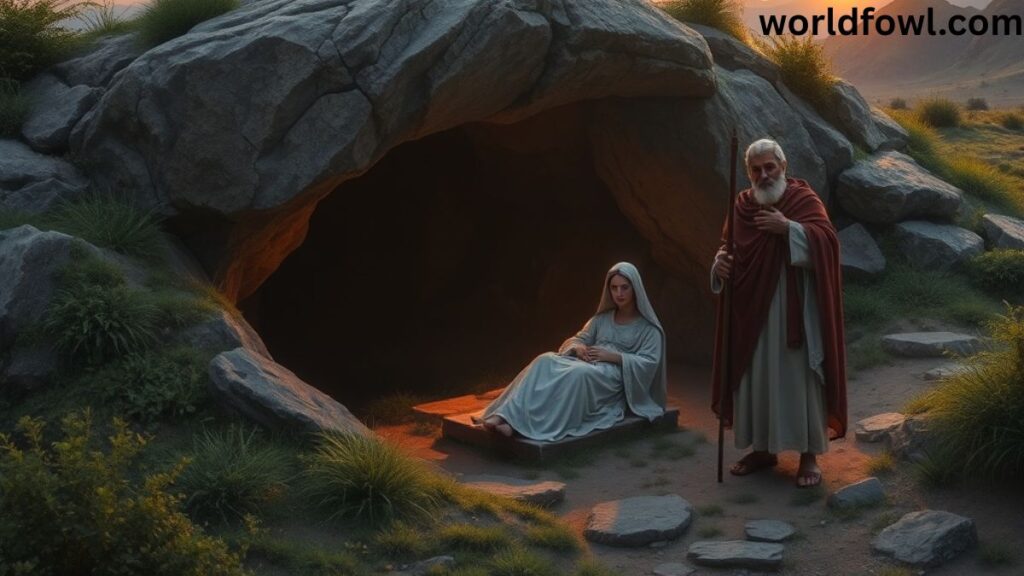
Sarah died at age 127 in Kiriath-arba (Hebron) in Canaan. Genesis 23 dedicates an entire chapter to Abraham’s purchase of her burial site—the Cave of Machpelah.
This was the first piece of the Promised Land that Abraham actually owned. He negotiated with Ephron the Hittite, paying 400 shekels of silver for the cave and the field surrounding it. The transaction was conducted publicly at the city gate with witnesses.
Why This Purchase Mattered
Abraham insisted on buying the property rather than accepting it as a gift. This legal purchase established his family’s legitimate claim to Canaan. The family burial site became a permanent anchor in the land God had promised.
The Cave of Machpelah became the final resting place for multiple patriarchs and matriarchs:
| Person Buried | Relationship | Significance |
|---|---|---|
| Sarah | Abraham’s wife | First matriarch |
| Abraham | Patriarch | Father of faith |
| Isaac | Sarah’s son | Covenant heir |
| Rebekah | Isaac’s wife | Second matriarch |
| Leah | Jacob’s wife | Third matriarch |
| Jacob | Isaac’s son | Israel |
The site remains significant today. The structure known as the Cave of the Patriarchs in Hebron is considered one of the oldest continuously sacred sites in the world, venerated by Jews, Christians, and Muslims.
The Symbolism of Sarah’s Burial
Sarah’s burial in Canaan represented faith in action. She died without seeing the full fulfillment of God’s promises. Her descendants didn’t yet possess the land. They were still sojourners.
Yet Abraham’s careful purchase of her burial plot demonstrated confidence that future generations would remain in Canaan. He was planting roots, establishing claims, declaring through this act that his family belonged to this land and this land to them.
Sarah was the first to be laid to rest in the Promised Land. Her burial inaugurated the family claim that would eventually expand to encompass the entire territory.
Additional Remarkable Facts About Sarah
She Lived Longer Than Any Named Woman in Scripture
Sarah’s lifespan of 127 years exceeds every other woman whose age is recorded in the Bible. This longevity itself seems like a blessing, allowing her to see Isaac grow into adulthood and marry Rebekah.
The midrashic tradition suggests that Sarah died from shock upon hearing about the binding of Isaac in Genesis 22. While Scripture doesn’t confirm this, the timing is suggestive—Genesis 22 describes the near-sacrifice, and Genesis 23 immediately begins with Sarah’s death.
Her Story Spans Multiple Books
Sarah’s influence extends beyond Genesis. She appears in:
- Isaiah 51:2: “Look to Abraham your father and to Sarah who bore you”
- Romans 4:19: Discussion of Abraham’s faith despite Sarah’s barrenness
- Romans 9:9: The promise concerning Sarah
- Galatians 4:21-31: Allegory of Sarah and Hagar
- Hebrews 11:11: Hall of Faith recognition
- 1 Peter 3:6: Model for women of faith
This extensive New Testament engagement with her story demonstrates her theological importance. She’s not just an Old Testament figure—she’s woven into Christian teaching about faith, promise, and God’s covenant.
She Represents Impossible Possibilities
Sarah’s story embodies the theme that nothing is impossible with God. When the visitors promised her a child, she laughed. God’s response became one of Scripture’s most memorable questions: “Is anything too hard for the Lord?” (Genesis 18:14).
This question echoes through biblical narratives. Mary’s conception of Jesus. Zechariah and Elizabeth having John the Baptist in old age. God specializes in miraculous intervention when human capability fails.
Sarah stands as the prototype for this pattern. Her womb was “as good as dead” (Romans 4:19), yet she conceived. Her story invites us to believe that God can accomplish what seems biologically, logically, and practically impossible.
Lessons From Sarah’s Life for Modern Believers
Faith Develops Over Time
Sarah didn’t start with perfect faith. She doubted, laughed, and tried to control outcomes. Yet she’s remembered as a woman of faith. This progression offers hope.
Trusting God doesn’t require flawless belief from day one. It requires staying engaged with God through the doubts, the delays, and the difficulties. Sarah’s inclusion in Hebrews 11 proves that ultimate trajectory matters more than momentary failures.
God Works Through Imperfect People
Sarah made significant mistakes. The She mistreated Hagar. She tried to manufacture God’s promise through human means. She lied about laughing.
Yet God still used her powerfully. He didn’t wait for her to achieve moral perfection before fulfilling His covenant promise through her. He worked with her, flaws and all.
This should encourage anyone who feels disqualified by past mistakes. God’s plan doesn’t depend on our perfection—it depends on His faithfulness.
Waiting Produces Character
Sarah’s decades of waiting on God weren’t wasted time. They refined her character, deepened her understanding, and prepared her for the miracle that finally came.
Modern culture despises waiting. We want instant results, immediate gratification, rapid solutions. Sarah’s story challenges this mindset. Some promises require decades to unfold. The waiting itself becomes part of the preparation.
God’s Timing Isn’t Ours
Sarah wanted a child at 65, or 70, or 75. God gave her one at 90. Why the delay? Scripture doesn’t fully explain, but the timing made the miracle undeniable.
If Isaac had been born when Sarah was younger, observers might have attributed it to natural causes. At 90, there was no mistaking God’s miraculous intervention. The impossibility of the situation magnified God’s glory.
God’s divine timing often frustrates us because we can’t see the full picture. Sarah’s story reminds us to trust that God knows what He’s doing, even when His timeline seems unreasonable.
The Enduring Legacy of Sarah
Sarah shaped history in ways that continue echoing today. The Jewish people trace their lineage through her. Christians see in her story a prototype of faith and promise. Muslims honor her as a matriarch of monotheism.
Her struggles with infertility, faith, and waiting on God remain deeply relatable. Millions of people today face similar challenges—biological clocks ticking, promises seeming unfulfilled, circumstances appearing impossible.
Sarah from the Bible offers more than historical interest. She provides a template for how faith functions in real life—messy, doubting, striving, and ultimately victorious through God’s power, not human effort.
The Her laughter transformed from cynicism to joy. Her barrenness became fruitfulness. Her doubt evolved into the kind of faith that earned recognition in Hebrews 11. If God could do that with Sarah, He can do remarkable things with anyone willing to stay engaged with His promises.
The Mother of nations started as a childless woman laughing bitterly at divine promises. She ended as a testament to God’s faithfulness that spans millennia. That’s the power of trusting God despite doubt, waiting on God’s timing, and participating in God’s redemptive plan even when it doesn’t unfold as expected.
Sarah’s story isn’t really about her at all—it’s about God, who keeps His covenant promises no matter how impossible they seem. She was simply the willing, if imperfect, vessel through whom He chose to demonstrate that truth. And that’s exactly what makes her story so powerful and her faith so worthy of emulation.
Conclusion
These 15 Interesting Facts About Sarah from the Bible reveal a woman far more complex than Sunday school lessons typically portray. She wasn’t perfect. She doubted, schemed, and struggled with faith just like we do. Yet God chose her to become the Mother of nations and positioned her prominently in His covenant with Abraham.15 Interesting Facts About Sarah from the Bible Her transformation from cynical laughter to joyful motherhood proves that God’s promises never fail, even when circumstances seem impossible. Sarah’s inclusion in Hebrews 11 wasn’t because she got everything right—it was because she ultimately trusted God’s faithfulness over her own limitations.
15 Interesting Facts About Sarah from the Bible demonstrate that God specializes in the impossible. The He gave a 90-year-old woman a child. He turned decades of infertility into fruitfulness. He redeemed her mistakes and used her imperfect faith to launch His redemptive plan for humanity. 15 Interesting Facts About Sarah from the Bible Sarah’s story offers hope to anyone waiting on God, struggling with doubt, or feeling disqualified by past failures. Her life proves that trusting God despite doubt isn’t about perfect belief—it’s about staying engaged with Him through every season, knowing His timing is always perfect.
FAQs
Q: What was Sarah’s original name in the Bible?
Q: What was Sarah’s original name in the Bible?
Sarah’s original name was Sarai, which means “my princess.” God changed it to Sarah (meaning “princess”) when she was 89 years old as part of His covenant promise in Genesis 17:15.
Q: How old was Sarah when she gave birth to Isaac?
Sarah was 90 years old when she gave birth to Isaac, making her pregnancy a miraculous intervention by God. Abraham was 100 years old at the time, as recorded in Genesis 21:5.
Q: Why is Sarah mentioned in Hebrews 11?
Sarah is honored in Hebrews 11:11 as one of the faith heroes because she ultimately believed God’s promise despite initial doubt. She’s one of only two women individually named in the Hall of Faith.
Q: Where is Sarah buried and can you visit the site today?
Sarah was buried in the Cave of Machpelah in Hebron. The site still exists today as the Cave of the Patriarchs, one of the world’s oldest continuously sacred sites, visited by thousands annually.
Q: What does Sarah’s story teach about faith and waiting?
Sarah’s 25-year wait for Isaac teaches that God’s timing differs from ours and that faith can coexist with doubt. Her story shows that trusting God means staying engaged through delays, not having perfect belief from the start.